Jigsaw Sudoku Rules
Sudoku where the nine regions are irregular jigsaw shapes instead of 3×3 boxes.
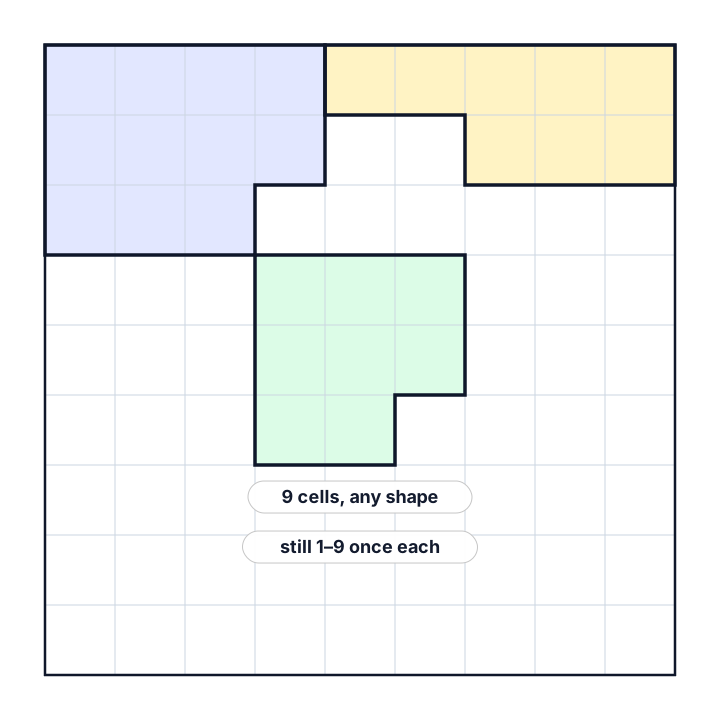
Jigsaw Sudoku (also called Squiggly or Geometric Sudoku) replaces the nine 3×3 boxes with nine irregular, interlocking regions. Every other rule stays the same: each of those regions, like each row and column, must contain 1–9 once.
The irregular regions change the geometry of the deductions, so familiar box-scanning patterns look different.
The rules
- Fill every cell with a digit from 1 to 9.
- Each row contains all nine digits once.
- Each column contains all nine digits once.
- Each irregular jigsaw region contains all nine digits once.
Irregular regions
Each region still holds nine cells and still needs the digits 1–9, but its shape winds across the grid. Because regions are not aligned to neat thirds, locked-candidate and pointing patterns become especially powerful.
Solving strategy
Jigsaw rewards the "law of leftovers": where a region and a band of rows or columns nearly coincide, the few cells of difference must contain the same digits. Comparing a region against the rows it mostly fills often pins a digit with no scanning at all. Beyond that, every classic technique applies — but think in terms of the squiggly region wherever you would normally use a box.
Pointing and box/line reduction are unusually strong here because a region can share many cells with a single row or column, so a digit confined to a region frequently collapses onto one line.
- Use the law of leftovers between a region and a row/column band.
- Substitute "region" for "box" in every box-based technique.
- Watch for regions that hug a single line — strong pointing eliminations.
A worked example
Let's walk the law of leftovers through one clean case. Pick the top three rows as your area. Three full rows always hold each digit 1–9 exactly three times. Now look at the jigsaw regions that those rows almost cover. Say three whole regions fit neatly inside rows 1–3 except that one of them pokes two cells down into row 4, and in their place two cells of row 3 are left uncovered. Those two uncovered cells (the "leftovers" inside the rows) and the two cells spilling into row 4 (the leftovers inside the regions) must contain exactly the same pair of digits.
Here is why, and here is the payoff. The three rows and the three regions cover almost the same cells, and both hold each digit the same number of times — so whatever the rows have that the regions don't must hold exactly the same digits as whatever the regions have that the rows don't. The two leftover sets are different cells in different places, yet they are locked to the identical pair of digits. Suppose the two uncovered cells in row 3 are limited to just 6 and 8 by the digits already sitting in their columns. By the law, the two spill cells down in row 4 must hold that same pair — so even if, looked at on their own, those row-4 cells still allowed several digits, they are now pinned to exactly 6 and 8 and every other candidate is wiped from them in a single stroke. You constrained two cells in row 4 by reading two cells in row 3, with no scanning at all — and that tightening usually unlocks the next move.
- Choose a band of whole rows (or columns) that nearly matches a set of whole regions.
- The cells inside the rows but outside those regions hold the same digits as the cells inside the regions but outside the rows.
- Whatever digits are pinned in one leftover set are exactly the digits in the other — copy the restriction straight across.
Frequently asked questions
- Are jigsaw puzzles harder than classic?
- Often slightly, because the irregular regions break the visual habits you build on 3×3 boxes — but the logic is identical.
- How many cells per region?
- Exactly nine, the same as a classic box; only the shape differs.
- What is the law of leftovers?
- A jigsaw-specific shortcut: when a region and a set of complete rows or columns cover almost the same cells, the small set of cells that differ must hold identical digits. It often forces a placement directly, without any candidate scanning.
Play Jigsaw Sudoku online
Free Jigsaw Sudoku puzzles in your browser — no download, no account needed.
Play Jigsaw Sudoku