About Sudoku247Wiki
Sudoku247Wiki is a free, independent, ad-free reference for the whole game of sudoku — funded by the sister play hub sudoku247online.com, with no paywall, no account and no tracking cookies. Here is what it is, how it is built, and how it is funded.
Sudoku247Wiki is the reference book for sudoku — written in plain English, free to read, and independent. Every rule of every variant, the vocabulary that makes the rest of the wiki readable, all 25 solving techniques from naked single to forcing chains, and the practical guides that turn knowledge into faster solves. One source for the whole game.
This page is the honest version of "about this site": what the wiki covers and what it deliberately leaves to the play hub, how the four clusters are organised, how the whole thing is funded so it can stay free and ad-free, and how it differs from the other sudoku references you may already know. If you just want to start solving, skip to "Your first thirty minutes" below.
What this wiki is, and what it is not
Sudoku247Wiki is a reference site, not a play site. It explains the rules of every popular sudoku variant, defines the vocabulary players use to talk about the puzzle, and documents every solving technique in enough detail to learn it from scratch. Each page is a single, self-contained article — there is no paywall, no account, no advertising, and no tracking cookies following you across the web. If you are looking for puzzles to play, sudoku247online.com hosts those; the wiki is the part you read when you want to understand what you are doing.
The wiki is also independent. It is not the in-house help text of a play app, so it is not tuned to sell you anything; and it is not a research-style encyclopedia, so it is not written for graduate logicians. It sits in the gap most existing sudoku references leave: rules-led where the puzzle is complicated, technique-led where the deduction matters, and beginner-friendly throughout. If you have ever tried to learn an X-Wing from a wall of dense notation, you know the gap.
- Free to read and ad-free — no account, no paywall, no tracking cookies.
- Independent — not the in-house help text of any play app.
- Complete — every rule, every variant, every solving technique we cover, with worked examples.
- Beginner-friendly throughout — plain English first, technical detail second.
How the wiki is organised — the four clusters
Everything indexed on the wiki sits under one of four clusters. They are arranged in the order most players grow through them, so reading them top to bottom is the recommended path; but each one stands alone, and you can drop in anywhere if a specific page is what you came for.
The first cluster is the basics. Ten short articles covering the vocabulary every player uses before any solving technique makes sense: the parts of the grid (cells, rows, columns, boxes, peers), what givens and candidates are, how pencil marks are written, the rNcN shorthand for naming a cell, and what each difficulty level actually means. Read this first if you have never solved a sudoku — about forty minutes end to end, and the last page walks you through your first puzzle.
The second cluster is how to play. This is the rules pillar and the seven per-variant rules pages — classic, killer, jigsaw, sudoku X, wordoku, 6×6 mini and 4×4 kids. The rules pillar is the puzzle in one sentence (each row, each column and each 3×3 box contains 1–9 once) and then everything you need to find your first move; the variant pages add the one rule each variant changes on top. Read this once and you can play any sudoku you find.
The third cluster is the techniques. Twenty-five named deduction rules, grouped beginner, intermediate and advanced, with a worked example on a real grid for each. Every technique either rules a candidate out of a cell or forces a digit into one — nothing more, nothing magical — and the techniques cluster explains which to learn first and how the ladder works above them. You only ever need a handful at a time; the catalog is for when a particular puzzle stalls.
The fourth cluster is the guides. Practical, end-to-end how-tos that sit above the reference material: the solving order to apply techniques in, how to solve faster, the mistakes that stall people, and a practice plan to actually improve. A guide is not a single rule — it is the discipline that strings rules together into a solve.
- Basics — vocabulary, parts of the grid, difficulty bands. Read first if you are new.
- How to play — the rules pillar plus seven per-variant rules pages.
- Techniques — twenty-five deduction rules, beginner to expert.
- Guides — solving order, solving faster, common mistakes, practice plans.
Independent, free, and ad-free — how the wiki is funded
Here is the honest answer to "what is the catch": there isn't one. The wiki is funded by its sister play hub, sudoku247online.com. The play hub is where people go to actually solve puzzles, and it is what pays for the reference to exist — so the wiki itself can stay completely free and clean. There is no paywall, no "create an account to keep reading" wall, no advertising slotted between paragraphs, and no tracking cookies following you around the web. The only measurement is privacy-friendly, cookieless page counts — no cookies, no profiles, nothing that follows you off the page — just an aggregate sense of which articles people find useful.
That funding model is also what we mean by independent. The wiki is not the in-house help text of a play app, written to push you toward a subscription or a download. It is not a content farm chasing ad impressions, so it has no reason to pad an article or bury the answer below the fold. And it is not sponsored by any puzzle publisher, so it can describe a technique plainly and compare itself honestly to the other references without picking favourites. The only thing the wiki asks in return is that if a page helps you, you give the play hub a try the next time you want to solve a puzzle.
Because there are no ads and no tracking cookies, the pages are also lighter and faster than most reference sites — the same plain-English, no-clutter approach that runs through the writing runs through how the pages are built.
- Funded by the sister play hub, sudoku247online.com — not by ads.
- No paywall, no account, no advertising, no tracking cookies.
- Independent — not the in-house help text of any play app, and not sponsored.
- The only ask: try the play hub when you want to actually solve.
How Sudoku247Wiki differs from the other sudoku references
The big existing references each cover one slice of the game well, and none of them cover the whole game cleanly. Wikipedia's sudoku article is excellent on history and mathematics but says little about how to solve. The community-maintained encyclopedias define every term but read like reference manuals — you go to them when you already know what you are looking for. The strategy-led sites are deep on advanced techniques but assume the basics. The play hubs include short tutorials that get you started but stop before the techniques bite.
This wiki sits across the whole game. The basics, the rules of every variant, every solving technique, and the practical guides that tie them together — all written in the same voice and cross-linked so each page leads to the next thing you should read. Each technique page includes an interactive demo grid that is generated by the same sudoku engine the play hub uses, so what you read about the puzzle and what you solve on the practice grid are the same puzzle.
- Wikipedia — strong on history; thin on solving.
- Sudopedia / SudokuWiki.org — strong on advanced techniques; assume the basics.
- Play-hub tutorials — strong introductions; stop before the techniques bite.
- Sudoku247Wiki — the whole game, one voice, one cross-linked reference.
Your first thirty minutes on the wiki
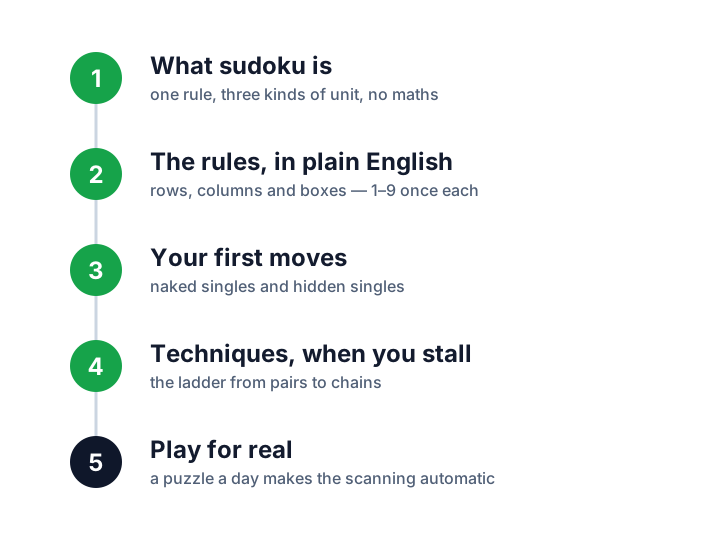
If you have never solved a sudoku, the fastest way in is a thirty-minute reading path. Start with what is sudoku for the puzzle in one minute, then read grid anatomy so the names of the parts of the grid land. From there, how to play covers the rules in plain English. By the bottom of that page you know enough to start solving.
Pick up your first solving move with the naked single — a cell with only one candidate left, the simplest deduction in sudoku — and pair it with the hidden single, a digit that has only one home left in a unit. Between those two techniques you can finish almost every easy puzzle and most medium ones. When you are ready for a guided solve, the first puzzle walkthrough takes you through one step by step.
After that, the order to keep growing is roughly: read the rest of the basics in any order, then climb the techniques cluster one tier at a time, then read the solving order guide to learn how to sequence what you know. That sequence is the same one most strong solvers followed.
- 1. What is sudoku — one-minute orientation.
- 2. Grid anatomy — the parts of the grid by name.
- 3. How to play — the rules pillar in plain English.
- 4. Naked single — your first solving move.
- 5. Hidden single — your second solving move.
- 6. First puzzle walkthrough — a guided first solve.
Where to dip in if you already know sudoku
If you already finish hard puzzles and want a specific technique sharpened, the techniques cluster is the index. The X-Wing, Swordfish and XY-Wing are the three pages most solvers look up by name; the full list groups them with their cousins. If you want the discipline rather than the patterns, the solving order guide is the ladder, solve faster is the speed-solver routine, and common mistakes is the things that stall a strong solver longer than they should.
If you came in for a variant — killer, jigsaw, sudoku X, wordoku — the per-variant rules pages carry the full rules and a worked introduction. And if you came in to settle a term, the glossary is the index of vocabulary with a deep link into the technique or basics page that defines it; the history of sudoku is the origin story and the timeline of how a constrained Latin square became the world's favourite logic puzzle.
Frequently asked questions
- How does sudoku247wiki.com relate to sudoku247online.com?
- They are sister sites with different jobs. Sudoku247online.com is the play hub — you go there to actually solve puzzles in any variant at any difficulty. Sudoku247wiki.com is the reference — you come here to read the rules, learn a technique or look up a term. The two share the same sudoku engine, so the interactive demo grids on the wiki and the puzzles on the play hub are the same puzzles; reading about a technique here and trying it on the play hub is one continuous experience. The play hub also funds the wiki, which is why the reference can stay free and ad-free.
- How is this wiki different from sudokuwiki.org or sudoku.com?
- SudokuWiki.org is solver-led: it is strongest on advanced techniques and on its in-browser solver, but assumes you already know the basics. Sudoku.com is a play hub with short tutorial pages that get you started but stop before the harder techniques. Wikipedia is strong on history and mathematics but light on solving. Sudoku247Wiki sits across the whole game — basics, every variant, every technique, and the practical guides — written in plain English and cross-linked so each page leads to the next.
- Do I need an account to use the wiki?
- No. There is no signup, no login, and no profile. Every page on sudoku247wiki.com is a public reference page you can read or link to directly. The interactive practice grids on the technique pages also run without an account — they generate a real puzzle from the shared engine and let you solve in the browser. If you want a profile, statistics or saved puzzles, those live on the play hub at sudoku247online.com instead.
- Is the wiki useful for advanced solvers too?
- Yes. The techniques cluster covers every named pattern from singles up through fish (X-Wing, Swordfish, Jellyfish), wings (XY-Wing, XYZ-Wing, W-Wing, Skyscraper, Empty Rectangle), unique rectangles, BUG, simple colouring and forcing chains. Each technique page carries a worked example on a real grid and links to the related patterns. If you want the discipline rather than the patterns, the solving order and solve faster guides are written for the solver who already knows the techniques and wants to apply them better.
Further reading
- Sudoku247Online — the play hub that funds this wiki — Sudoku247
- Sudoku — Wikipedia
- Glossary of Sudoku — Wikipedia
- Solving Techniques — overview — HoDoKu
Practice online
Put it into practice on free puzzles with hints, notes and four difficulty levels.
Play Sudoku