The Right Order to Solve a Sudoku
A repeatable solving workflow — which technique to try first, what to reach for when you stall, and how to never waste a scan.
Most people who get stuck are not missing a technique — they are applying techniques in the wrong order, hunting for an X-Wing while a hidden single sits unplaced two boxes over. A good solve is a disciplined pass through a fixed ladder of moves, simplest first, only escalating when nothing easier remains.
This guide gives you that ladder. Follow it top to bottom on every puzzle and you will both solve faster and stop second-guessing what to look at next.
The solving ladder
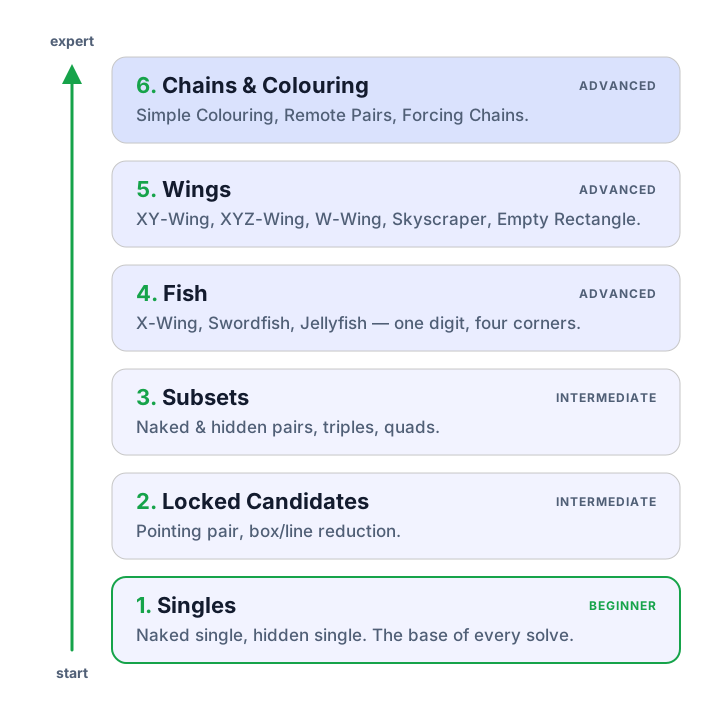
Always try the cheapest move that can still make progress. Each rung only becomes worthwhile once the rung above it stops producing placements, because every advanced technique exists purely to create a new single somewhere simpler.
- 1. Naked & hidden singles — place everything forced before anything else.
- 2. Locked candidates — pointing pairs and box/line reduction.
- 3. Naked & hidden subsets — pairs, then triples, then quads.
- 4. Fish — X-Wing, then Swordfish and Jellyfish.
- 5. Wings — XY-Wing, XYZ-Wing, W-Wing, skyscraper.
- 6. Colouring & chains — simple colouring, remote pairs, forcing chains.
When to fill in pencil marks
Do not pencil-mark the whole grid immediately. Solve the easy singles by eye first — they need no notes and clear away clutter. Only once box-scanning stops yielding hidden singles is it worth investing in full candidate marks, at which point naked pairs, subsets and fish become visible. Marking too early just gives you more to erase.
Re-scan after every placement
Each digit you place removes candidates from its row, column and box, which often creates a fresh single nearby. After placing a digit, glance at its three units before moving on. Returning to the top of the ladder after every placement — rather than ploughing ahead with advanced moves — is the single biggest speed-up most solvers can make.
Try it yourself
Tap a cell, then a number, to practise.
Frequently asked questions
- Should I always start with hidden singles?
- Yes. Box-scanning for hidden singles fills a grid fastest in the early stage and needs no pencil marks. Switch to naked singles and subsets once you have full candidates.
- When is it time to use an advanced technique?
- Only when a full pass of singles, locked candidates and subsets produces no placement. If a simpler move still works, an advanced one is wasted effort.
- I have full pencil marks and I am still stuck — what now?
- Work up the ladder in order: scan for fish on a single digit, then wings on bi-value cells, then a colouring pass. A methodical sweep almost always finds the next elimination faster than random staring.
More guides
Further reading
- Strategy Families (the order strategies are tried) — SudokuWiki.org
- Human Style Solving Techniques — HoDoKu
Practice online
Put it into practice on free puzzles with hints, notes and four difficulty levels.
Play Sudoku