Sudoku Solving Techniques
A sudoku technique is a deduction rule for narrowing down where a digit can go. This is the full library — 25 of them, ordered from beginner to expert, with what each one is for and which to learn first.
A sudoku technique is a logical rule that lets you eliminate candidates or place a digit without guessing. Every technique does one of two things: it either rules a candidate out of a cell, or it forces a digit into one. Stack enough of those small deductions and the whole grid falls.
This is the wiki's catalog of 25 techniques, grouped by difficulty. The hard ones do not solve "harder" puzzles by being cleverer — they solve them by handling positions where the simple techniques run out. Most of the time you only need a handful. Read on for which ones are worth your time first, and how the ladder works above them.
What "sudoku technique" actually means
Every technique on this page is a deduction rule, not a trick. It says: in a position that looks like this, you can either eliminate this candidate from that cell, or place this digit here. Nothing more, nothing magical. The reason there are dozens of named techniques is that solvers (and computer programs) wanted vocabulary for the shapes that keep coming up — the rectangle, the chain of three cells, the same digit twice in two rows — so they could spot them faster.
Sudoku is a logic puzzle. In a properly made puzzle there is exactly one solution, and every move along the way is forced by the rule that each row, each column and each 3×3 box must contain 1–9 once. So a technique is not how you "decide" what to put in a cell — it is how you prove there is only one legal answer. If a technique ever seems to require a guess, you have either missed a deduction or the puzzle is broken.
- A technique either eliminates a candidate from a cell, or places a digit in one.
- Every elimination chains back to the same rule: 1–9 once per row, column and box.
- Sudoku does not require guessing — if it feels like it does, look again.
- Named techniques are pattern shortcuts, not extra rules.
The ladder from beginner to advanced, in plain English
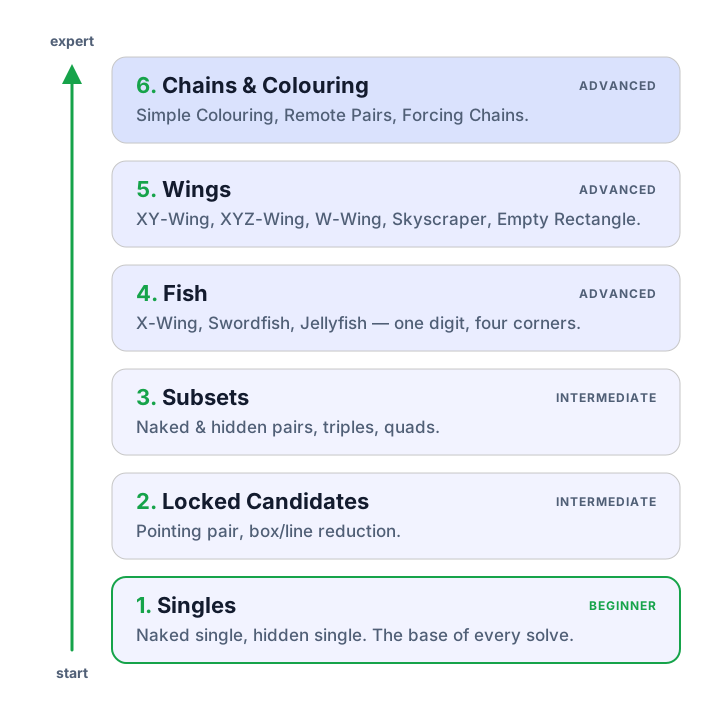
Techniques are usually grouped in six tiers, each one solving a deeper class of puzzle. The wiki tags every article with one of three difficulty bands — beginner, intermediate, advanced — that bundle these tiers for browsing. The order is roughly the same everywhere, because each rung depends on the one below it.
The good news: most published puzzles never reach above the middle of this ladder. Easy puzzles fall to singles alone. Medium puzzles need pairs and locked candidates. Hard puzzles need an X-Wing or a wing pattern. Only expert and "evil" puzzles routinely demand chains — and they reward you for having clean candidates more than for having memorised every chain shape.
- Singles — naked single, hidden single. One cell, one digit at a time.
- Locked candidates — pointing pair, box/line reduction. A digit pinned to a line inside a box.
- Subsets — naked and hidden pair, triple, quad. Two, three or four candidates that lock onto the same cells.
- Fish — X-Wing, Swordfish, Jellyfish. One digit, rectangular alignment across rows and columns.
- Wings — XY-Wing, XYZ-Wing, W-Wing, Skyscraper, Empty Rectangle. Short chains of two-candidate cells.
- Chains and colouring — Simple Colouring, Remote Pairs, Forcing Chains. Long chains of forced inferences.
Which technique to learn next, given where you are
If you have never solved a sudoku, start with the rules and then with the two singles. The naked single is a cell where only one candidate is still legal; the hidden single is a digit that has only one cell left in a row, column or box. Between them they finish almost every easy puzzle and most medium ones. Practise them until the scanning is automatic, even on grids where you have not written candidates down. The technique pages for the naked single and the hidden single each walk through one on a real grid.
If you can already finish a medium puzzle but stall on hard, learn locked candidates next. They are how a 1 in one box can rule a 1 out of every other box in the same row — the single most useful intermediate move. Then naked pairs and triples, and only after those, fish and wings. There is no honour in jumping straight to XY-Wing; you will see two of them per puzzle if you are lucky, and miss easier moves every page. The solving order guide maps the ladder one step at a time.
If you already solve hard puzzles and want expert, the upgrade is fluent candidate notation, not more named patterns. Most chains live inside the candidates; you cannot see them without legible pencil marks. Read the solve faster guide for the speed-solver routine, and treat each new technique as something you reach for only when the simpler ones genuinely fail to move the grid.
How the wiki organises 25 techniques
Under this essay you will find every technique we cover, grouped into beginner, intermediate and advanced. The cards are deliberately blunt: one summary line each, no jargon, click through for the deduction in full with a worked example. Each article carries the same structure — how to spot it, why it always works, a numbered worked example, common confusions, and a small set of FAQ answers.
The grouping follows the ladder above, with two small concessions to how players actually learn. The single most useful early intermediate move — pointing pair — is grouped with locked candidates, because that is where it belongs logically, even though you can find one before you have learned pairs. And Snyder notation sits in intermediate even though it is technically a notation choice not a deduction, because it changes how you scan more than most pairs do.
- Beginner — naked single, hidden single, naked pair. The two singles you cannot live without, plus the first elimination pattern.
- Intermediate — hidden pair, naked and hidden triples, naked quad, pointing pair, box/line reduction, Snyder notation. Everything most hard puzzles need.
- Advanced — hidden quad, every fish, every wing (including Y-Wing and XY-Wing), Skyscraper, Empty Rectangle, Simple Colouring, Remote Pairs, Unique Rectangle, BUG and Forcing Chains. The toolkit for expert grids.
What to read next
If you are new, start with the naked single and the hidden single — they will carry you through every easy and most medium puzzles. After those, read how to play for the rules in plain English and the solving order guide for the order to apply techniques in once you have more than a couple under your belt. The catalog grid below the essay is the rest of the library; browse it any time a puzzle stalls and you want to know which deduction you might be missing.
Browse the catalog
Beginner
Naked Single
A cell with only one possible candidate left — the most fundamental solving move in Sudoku.
Hidden Single
A digit that fits in only one cell of a row, column, or box — even when that cell still has other candidates.
Naked Pair
Two cells in a unit sharing the same two candidates lock those digits out of every other cell in that unit.
Intermediate
Hidden Pair
Two digits that can go in only the same two cells of a unit — clearing all other candidates from those cells.
Naked Triple
Three cells in a unit whose candidates together use only three digits lock those digits out of the rest of the unit.
Hidden Triple
Three digits that can live in only the same three cells of a unit — clearing every other candidate from those cells.
Naked Quad
Four cells in a unit whose candidates together use only four digits lock those digits out of the rest of the unit.
Pointing Pair
When a digit in a box is confined to one row or column, it can be eliminated from the rest of that row or column.
Box/Line Reduction
When a digit on a line is confined to one box, it can be eliminated from the rest of that box.
Snyder Notation
A disciplined pencil-marking method that records only hidden-pair candidates inside boxes to find singles faster.
Advanced
Hidden Quad
Four digits confined to the same four cells of a unit — every other candidate is stripped from those cells.
X-Wing
A rectangle of four candidate cells for one digit that eliminates that digit from two crossing lines.
Swordfish
A three-line generalisation of the X-Wing for a single digit, eliminating it across three crossing lines.
Jellyfish
A four-line fish: the same single-digit pattern as X-Wing and Swordfish, scaled to four rows and four columns.
XY-Wing
Three bi-value cells forming a hinge that eliminates a shared candidate from cells seeing both wings.
Y-Wing
Another name for the XY-Wing — a three-cell bi-value hinge that removes a shared candidate.
XYZ-Wing
An XY-Wing with a three-candidate pivot — the shared digit is eliminated from cells that see all three wing cells.
W-Wing
Two matching bi-value cells joined by a strong link on one digit eliminate the other digit from cells seeing both.
Skyscraper
A single-digit chain on two lines with one shared cross-line, eliminating the digit where the far ends see common cells.
Empty Rectangle
A box where a digit forms an L-shape, combined with a conjugate pair on a line, forces an elimination at their intersection.
Simple Coloring
Two-colour chaining of a single digit’s strong links to expose contradictions and eliminations.
Remote Pairs
A chain of bi-value cells all sharing the same two candidates lets you eliminate both digits from cells seeing each end.
Unique Rectangle
Exploits the fact that a valid puzzle has one solution to avoid a deadly four-cell rectangle.
BUG (Bivalue Universal Grave)
A uniqueness shortcut: when every unsolved cell is bi-value except one, the odd candidate is the answer.
Forcing Chains
Follow the consequences of a candidate being true or false until every path forces the same conclusion.
Frequently asked questions
- Which sudoku techniques should I learn first?
- The naked single and the hidden single. A naked single is a cell where eight of nine digits are already used in its row, column or box, leaving one legal candidate. A hidden single is a digit that has only one cell left in a unit. Between them they solve almost every easy puzzle and most medium ones, and every harder technique exists to create more singles. Do not move on until both feel automatic.
- What is the difference between beginner and advanced sudoku techniques?
- Beginner techniques act on one cell or one unit at a time — they find a cell that has only one option, or a digit that has only one home. Advanced techniques look across multiple rows, columns or boxes at once and use longer chains of inference. They do not let you solve cells the rules forbid; they just spot eliminations the simple techniques cannot see. You need them on hard and expert puzzles, almost never on easy ones.
- Do I need to memorise every sudoku technique?
- No. Most published puzzles are solvable with five or six techniques: naked single, hidden single, naked pair, pointing pair, box/line reduction, and one of X-Wing or XY-Wing for the hardest grids. Even strong solvers reach for the rest rarely. Learn techniques when a puzzle actually stalls — chasing every named pattern up front is a slower path to fluency than mastering the basics.
- What technique solves the hardest sudoku puzzles?
- There is no single technique that cracks every hard puzzle. Expert and "evil" puzzles usually need a mix: clean pencil marks, fluent fish and wing spotting (X-Wing, XY-Wing, Skyscraper), and chains or colouring on the very hardest positions. Forcing Chains is the most general advanced tool — given enough patience it solves anything a human is meant to solve — but it is also the slowest, so most solvers exhaust the named patterns first.
- Is a sudoku "technique" different from a "strategy"?
- Not really. Both words refer to a named deduction rule for eliminating candidates or placing digits. Some references prefer "technique" for individual rules (Naked Single, X-Wing) and "strategy" for how you sequence them when solving — scan, mark, look for pairs, then fish — but the boundary is loose. The wiki uses "technique" throughout for the rules and "guide" for the sequencing advice.
- Can a sudoku ever require guessing?
- Not a properly made one. A real sudoku has exactly one solution that can be reached by logic alone — though hard ones may need advanced techniques to find it. If a puzzle appears to require a guess, either you have missed a deduction or the puzzle is broken. Reputable publishers and generators run every puzzle through a solver before shipping it, precisely to confirm the logic path exists.
What to learn next
Where to go after this hub — start here if you are new, then come back to the catalog as you progress.
Naked single
The simplest technique: a cell with only one legal digit left.
Hidden single
A digit with only one cell left in a row, column or box.
How to play sudoku
The three rules, the parts of the grid and how to find your first move.
The right order to solve
Which technique to try first, second and last as a puzzle hardens.
Further reading
- Strategy Families — sudokuwiki.org
- Solving Techniques — overview — HoDoKu
- Glossary of Sudoku — Wikipedia
More from the blog
Blog →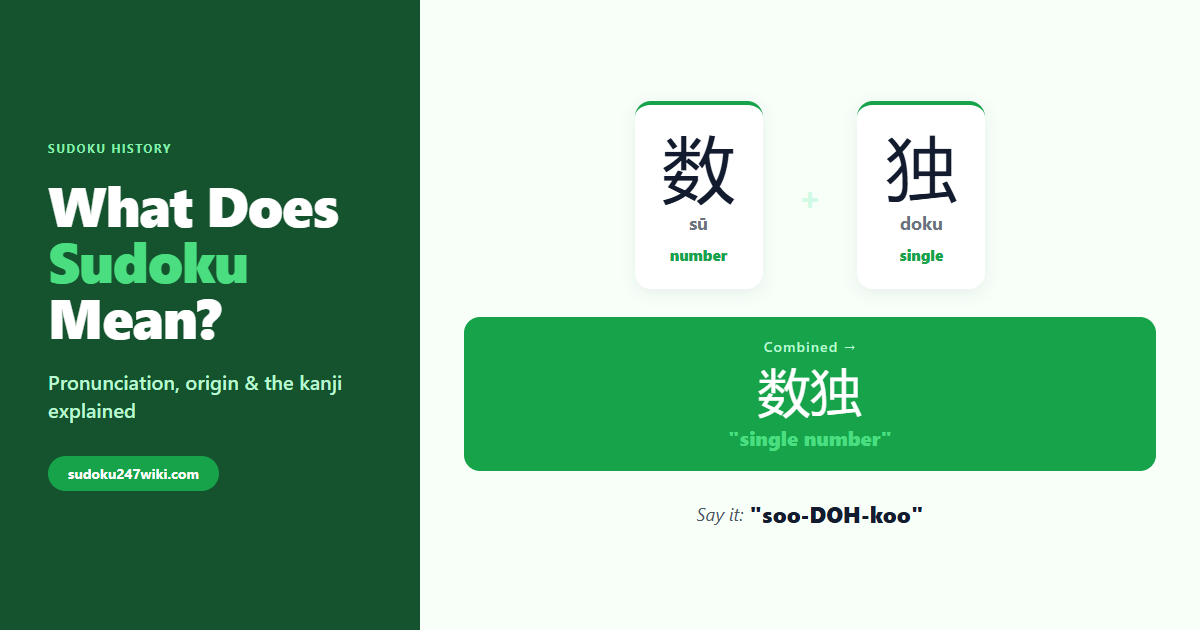 What Does Sudoku Mean? Pronunciation, Origin & HistoryHow do you pronounce sudoku, and what does it mean? It’s “soo-DOH-koo” — Japanese for “single number.” Here’s the meaning, origin and short history.Read article →
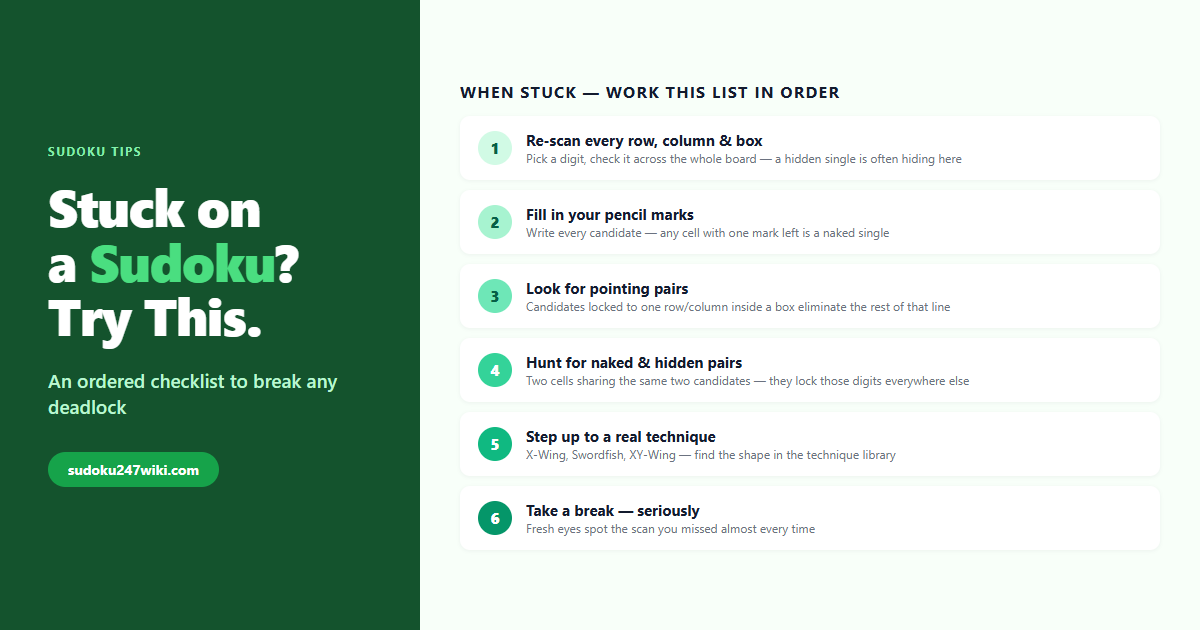 Stuck on a Sudoku? Here’s Exactly What to Try NextStuck on a sudoku with no obvious move? Work through this ordered checklist — re-scan, pencil marks, locked candidates, pairs — to break the deadlock.Read article →
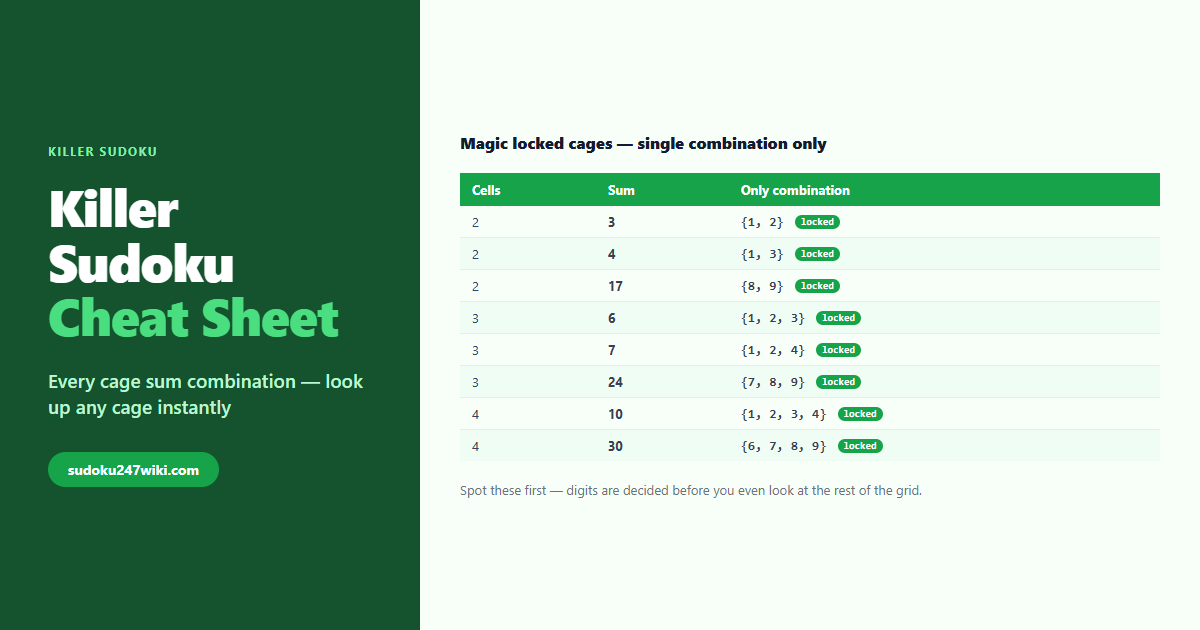 Killer Sudoku Cheat Sheet: Every Cage Sum CombinationThe complete killer sudoku cheat sheet: every 2-, 3- and 4-cell cage sum and its possible digit combinations, plus how to use the tables to solve faster.Read article →
Practice online
Put it into practice on free puzzles with hints, notes and four difficulty levels.
Play Sudoku