Stuck on a Sudoku? Here’s Exactly What to Try Next
Published Jul 8, 2026
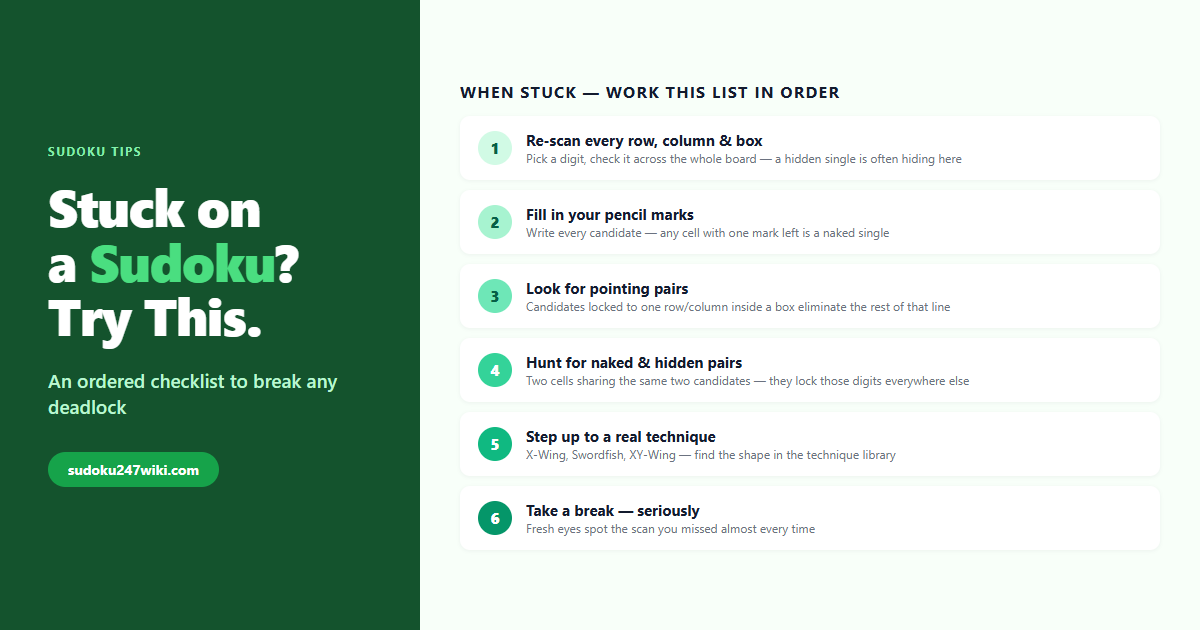
Stuck on a sudoku with no obvious next move? Take a breath — you almost certainly don’t need to guess. A properly made sudoku always has exactly one solution you can reach by pure logic, which means the next move is hiding somewhere on the grid right now. This is the ordered checklist to find it: work down the list in order, and stop the moment a step gives you a new number.
First, don’t guess
Here’s the most important thing to know when you’re stuck: every valid sudoku has one — and only one — logical solution. You never have to guess. If a puzzle came from a reputable source, there is always a deduction available, even when it doesn’t feel like it.
Why does this matter? Because guessing is how good progress turns into a tangled mess. Put a wrong number in early and you can fill ten more cells before the contradiction shows up — and by then you can’t tell which cell started the error. So we don’t guess. We escalate. Each step below asks a little more of you than the last, and one of them will break the deadlock.
Step 1: Re-scan every row, column and box
Before anything clever, scan again — slowly. When you’re stuck, it’s usually because you stopped looking, not because there’s nothing to find. The fastest win is a hidden single: a cell that’s the only place left in its row, column or box where a particular digit can go.
Pick one digit, say 7, and check it across the whole board. In each box, ask: where can a 7 still go? Cross out any cell already blocked by a 7 in the same row or column. Often a single empty cell survives — that’s a forced 7. Do this for every digit, one at a time. It’s slow, it’s a little boring, and it solves more “impossible” positions than any advanced trick. If you’d like a refresher on systematic scanning, our how to play guide walks through it from scratch.
Step 2: Fill in your pencil marks
If scanning isn’t enough, it’s time to write down what you know. Pencil marks are the small candidate numbers you note in the corner of each empty cell — every digit that could still legally go there. Once they’re on the grid, you stop holding the whole puzzle in your head and start reading the answers off it instead.
Go cell by cell and mark every digit not already used in that cell’s row, column or box. The payoff is immediate: any cell that ends up with just one candidate is a solved cell — that’s a naked single. And full pencil marks are the foundation for every technique that follows, so this step is never wasted. Our guide to using pencil marks covers a clean, consistent way to lay them out.
Step 3: Look for locked candidates (pointing pairs)
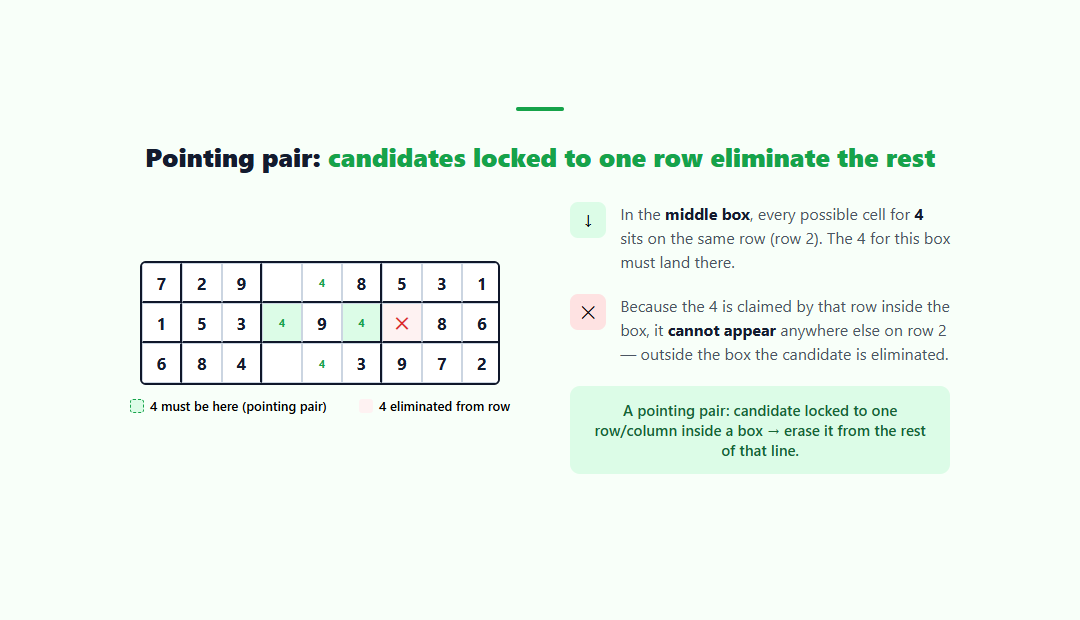
With pencil marks in place, start looking for patterns — and the first one to learn is the pointing pair, also called a locked candidate. It’s the simplest technique that eliminates candidates instead of placing a digit, and that’s often exactly what an unsticking move needs to do.
Here’s the idea. Look inside a single box and pick a candidate digit — say 4. If every 4 left in that box sits in the same row (or the same column), then the 4 for that box must land on that line. So the 4 can’t appear anywhere else along that same row or column outside the box — and you can erase those candidates. You haven’t placed a number yet, but you’ve cleared the clutter, and a cleared cell often becomes a naked single. Learn the full pattern on our pointing pairs page.
Step 4: Hunt for naked and hidden pairs
Next up the ladder are pairs. They come in two flavours, and learning to spot both will unstick the great majority of medium and hard puzzles.
A naked pair is two cells in the same row, column or box that share the exact same two candidates — say both hold only {3, 8}. Between them, those two cells will take the 3 and the 8 in some order, so 3 and 8 can be removed from every other cell in that unit. A hidden pair is the mirror image: two digits that can only go in the same two cells of a unit, even though those cells also show other candidates. When you find one, you can erase all the other candidates from those two cells, because that pair has claimed them. Both moves shrink your options fast — and shrinking options is how stuck positions open up.
Step 5: Step up to a real technique
Still stuck after pairs? Then the puzzle is genuinely hard, and it’s time for a stronger pattern. This is the good kind of stuck — the puzzle is teaching you something new.
The classic next step is the X-Wing: a candidate that appears in exactly two cells on each of two rows, with those cells lined up in the same two columns, lets you eliminate that candidate from the rest of those columns (and the same trick works with rows and columns swapped). Beyond it sit Swordfish, XY-Wing, coloring and more. Don’t try to memorise them all at once — browse the techniques library, find the one that matches the shape in front of you, and add it to your toolkit one puzzle at a time.
Step 6: Take a break — seriously
If you’ve worked the whole ladder and you’re still staring at the same grid, walk away. This isn’t giving up — it’s a real technique. When you stop, your brain stops forcing the move it expected to find and quietly notices the one that’s actually there.
Make a drink, stretch, sleep on it. Come back and your eyes will land on a scan you skipped or a pair you read past, almost every time. And if you want to make these moves faster and skip the deadlocks altogether, our guide to solving sudoku faster turns this checklist into habit.
Frequently asked questions
Why do I keep getting stuck on sudoku?
Almost always for one of two reasons: you’re scanning too quickly and missing forced cells, or you’re trying to solve in your head without pencil marks. Slow your scan down and write your candidates in — those two habits clear most “stuck” positions before you need any advanced technique.
Is the puzzle broken if I can’t find a move?
It’s very unlikely. A sudoku from a reputable source has exactly one logical solution, so a valid next move always exists — you just haven’t spotted it yet. The puzzle can only be truly broken if it has no solution or more than one, which means a clue was mistyped. If you suspect that, recheck your earlier entries first: a wrong number you placed yourself is a far more common cause of a dead end than a faulty puzzle.
Should I ever guess when I’m stuck on a sudoku?
No. Because every valid puzzle is solvable by logic, guessing is never required — and it usually backfires, since a wrong guess can let you fill in several more cells before the contradiction appears, leaving you unsure which entry was the mistake. Work the checklist instead. If you’re completely stuck, take a break and re-scan with fresh eyes rather than reaching for a guess.
More from the blog
- What Does Sudoku Mean? Pronunciation, Origin & HistoryHow do you pronounce sudoku, and what does it mean? It’s “soo-DOH-koo” — Japanese for “single number.” Here’s the meaning, origin and short history.
- Killer Sudoku Cheat Sheet: Every Cage Sum CombinationThe complete killer sudoku cheat sheet: every 2-, 3- and 4-cell cage sum and its possible digit combinations, plus how to use the tables to solve faster.
- How to Solve Sudoku Faster: Smart Habits, Not RushingWant to solve sudoku faster? Learn the scanning discipline, notation and pattern-spotting habits that cut your time — without rushing into mistakes.
Practice online
Put it into practice on free puzzles with hints, notes and four difficulty levels.
Play Sudoku