How to Get Better at Sudoku: A Beginner-to-Pro Plan
Published Jun 17, 2026
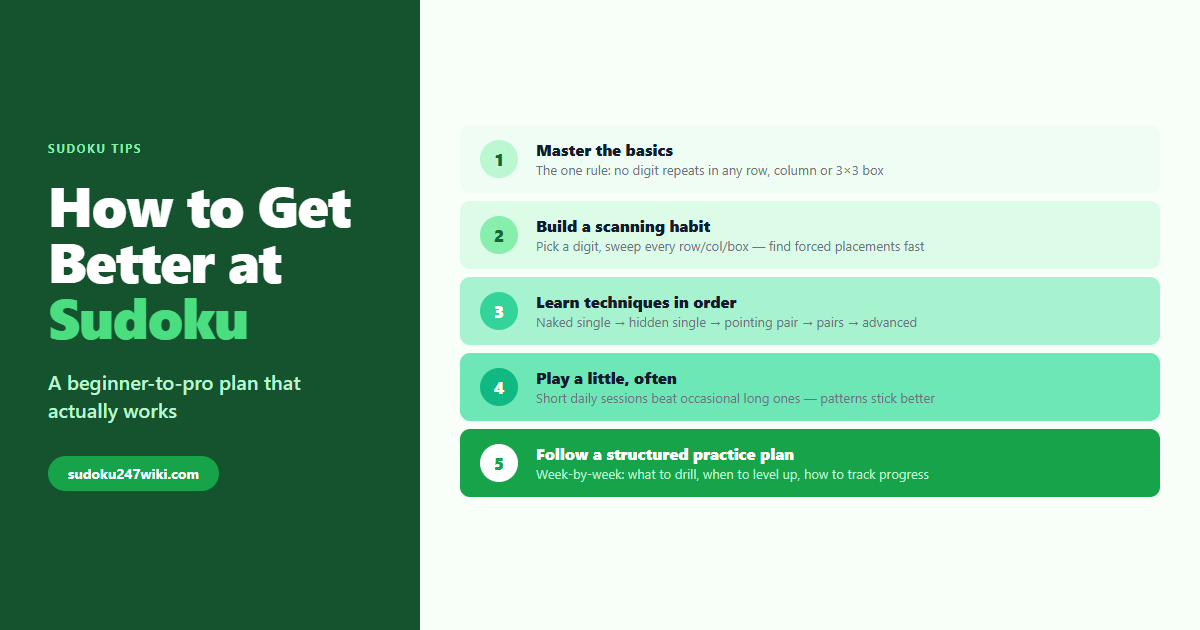
Want to get better at sudoku? The honest answer is that almost nobody is “naturally good” at it. People who solve hard puzzles with ease got there by practising the right skills in the right order — and you can follow the same path. This post lays out that path as a simple progression, from finishing easy grids to spotting patterns most beginners walk straight past.
Think of it as a roadmap. Each step below is a skill to build, with a link to where you can learn it properly. Work through them in order and you will improve faster than if you just grind random puzzles and hope something clicks.
Getting better is about practice, not talent
Here is the reassuring truth: sudoku is a logic game, not a memory test or an IQ test. Every puzzle is solvable by reasoning alone, with no guessing required. That means improvement is a skill you train, not a gift you are born with.
What separates a confident solver from a frustrated one is rarely raw brainpower. It is method — knowing what to look for, and looking for it in a sensible order. Once you learn the patterns, your eyes start finding them automatically. The puzzle stops feeling like a wall and starts feeling like a conversation.
So if you have ever stared at a grid and thought “I’m just not a sudoku person,” let that go. You are a sudoku person who hasn’t learned the next technique yet. Let’s fix that.
Step 1: Master the basics first
Before any clever tricks, make sure the foundation is solid. The one rule of sudoku is simple: every row, every column and every 3×3 box must contain the digits 1 to 9 with no repeats. Everything you will ever do flows from that single rule.
If you are still shaky on how the grid is laid out or how the rule plays out in practice, start at the sudoku basics hub. It walks you through reading a grid, the no-repeat rule, and how to place your first confident numbers. Spend a little time here — a strong base makes every later step easier.
Step 2: Build a scanning habit
If you only learn one beginner skill, make it scanning. Scanning means looking across rows, down columns and inside boxes to ask one question: “where can this digit go, and where can it not?” It is the engine behind nearly every solve.
The trick is to scan in a consistent order instead of darting around the grid at random. Pick a digit, sweep the whole board for it, then move to the next. A tidy routine catches placements your eyes would otherwise skip. To see how the grid is structured and how to read it cleanly, work through the anatomy of a sudoku grid.
Scanning is also where you build speed. Not by rushing — by removing wasted glances. The more deliberate your scan, the faster the answers appear.
Step 3: Learn techniques in the right order
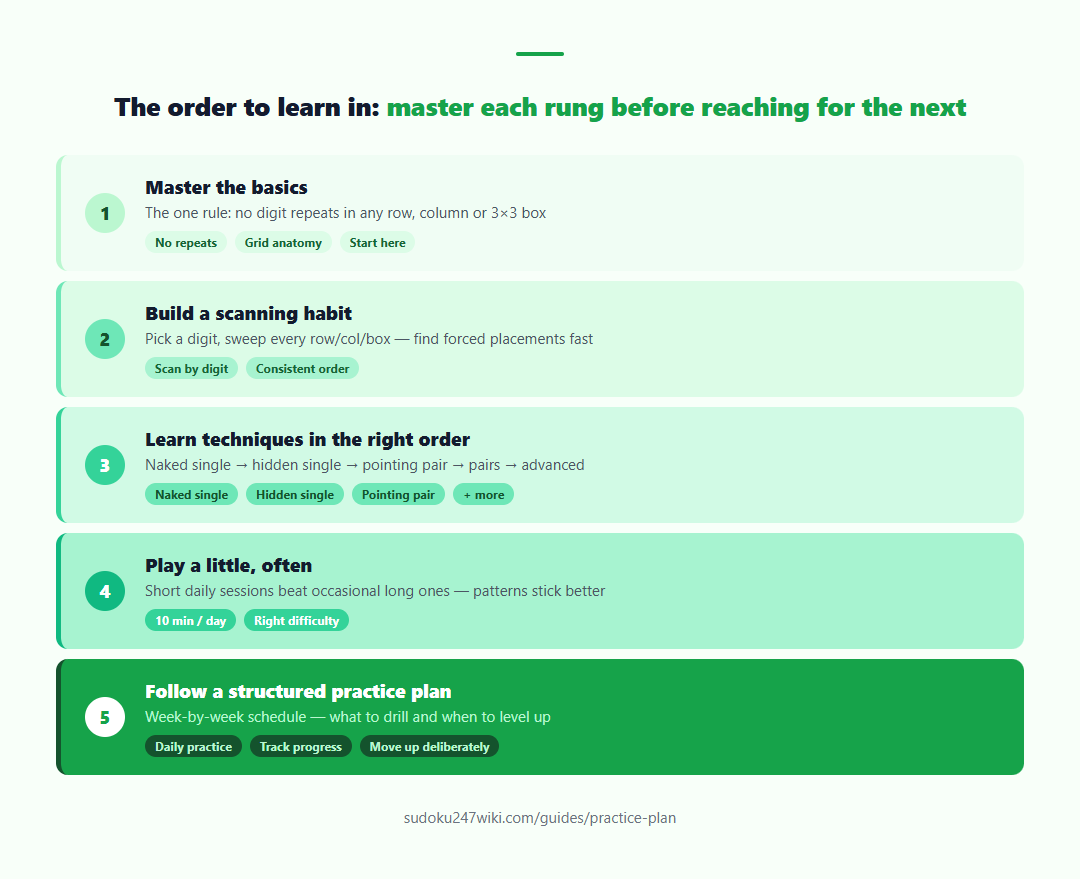
This is where most self-taught players stall. They try to jump to flashy advanced patterns before they own the simple ones — and bounce off. Techniques build on each other, so the order matters as much as the technique itself.
Here are the first three to learn, in order. Each links to a full walkthrough with a worked example you can follow at your own pace:
- Naked single — a cell where only one digit can possibly fit. The simplest, most satisfying placement there is.
- Hidden single — a digit that can only go in one cell of a row, column or box, even if that cell looks like it has options. This one unlocks far more than the naked single.
- Pointing pair — your first real “elimination” pattern, where a digit confined to part of a box clears it from a whole line. This is the bridge from beginner to intermediate.
Master those three before reaching higher. When you are ready for the whole ladder — from these singles up to the advanced patterns — browse the full sudoku techniques library. It is organised from easiest to hardest, so you always know what to learn next.
Step 4: Play a little, often
One puzzle a day beats ten puzzles once a week. This isn’t a guess — it is one of the most reliable findings in learning science. Spreading practice out over time (rather than cramming it into one long session) helps your brain move what you learn into long-term memory, so the patterns actually stick. Indiana University’s teaching center sums it up plainly: massed “cramming” produces drastic drops in performance compared with spaced practice.
For sudoku, that means short, regular sessions are your friend. Ten focused minutes most days will take you further than a marathon weekend that leaves you tired and frustrated. Little and often keeps the patterns fresh and your motivation high.
And play at the right level. Choose a difficulty where you stall once or twice per puzzle, not one where you are stuck on every cell. A puzzle that stretches you a little — without breaking you — is where real improvement happens.
Step 5: Follow a structured plan
Knowing the steps is one thing. Having a schedule that tells you exactly what to practise each week — and when to move up a difficulty band — is what turns scattered effort into steady progress.
We built one for you. Follow our full sudoku practice plan for a week-by-week schedule: which technique to drill, which difficulty to play, and how to tell when you are ready to level up. It is the detailed reference that turns this roadmap into a routine — so you are never guessing what to do next.
Pair that plan with the steps above and you have everything you need. Solid basics, a clean scanning habit, the right techniques in the right order, regular practice, and a schedule to hold it all together. That is how people actually get good at sudoku.
Frequently asked questions
How long until I get better at sudoku?
Most people notice a real difference within a few weeks of short, regular practice. Learn one new technique at a time, play most days, and you will feel easy puzzles speed up first, then watch medium puzzles open up. There is no fixed timeline — but consistent, ordered practice beats occasional bursts every time.
Should I time myself when practising sudoku?
While you are learning, no. Timing yourself early encourages rushing and guessing, which builds bad habits. Focus on solving cleanly with logic first. Once a difficulty level feels comfortable, a timer becomes a fun way to measure progress and push your speed — but accuracy always comes before the clock.
Which difficulty should I practise at to improve?
Practise one band below frustration: a level where you stall once or twice per puzzle but can finish without guessing. If you breeze through with no pauses, move up. If you get stuck on nearly every cell, drop down and solidify the technique you are missing. That sweet spot is where you improve fastest.
More from the blog
- What Does Sudoku Mean? Pronunciation, Origin & HistoryHow do you pronounce sudoku, and what does it mean? It’s “soo-DOH-koo” — Japanese for “single number.” Here’s the meaning, origin and short history.
- Stuck on a Sudoku? Here’s Exactly What to Try NextStuck on a sudoku with no obvious move? Work through this ordered checklist — re-scan, pencil marks, locked candidates, pairs — to break the deadlock.
- Killer Sudoku Cheat Sheet: Every Cage Sum CombinationThe complete killer sudoku cheat sheet: every 2-, 3- and 4-cell cage sum and its possible digit combinations, plus how to use the tables to solve faster.
Practice online
Put it into practice on free puzzles with hints, notes and four difficulty levels.
Play Sudoku