Killer Sudoku Cheat Sheet: Every Cage Sum Combination
Published Jul 1, 2026
This is the killer sudoku cheat sheet you keep open while you solve. Below are the complete cage-sum combination tables — every 2-, 3- and 4-cell cage sum and the exact digit combinations that can fill it. Look up the sum printed on a cage, read across, and you instantly know which digits are even allowed inside it. That single lookup is the fastest way to turn a wall of empty cages into placed numbers.
Every combination here was generated by listing all valid digit sets and checked against published killer-sudoku references, so you can trust the tables and just solve. New to the variant? Skim the killer sudoku rules first, then come back and bookmark this page.
How to use this killer sudoku cheat sheet
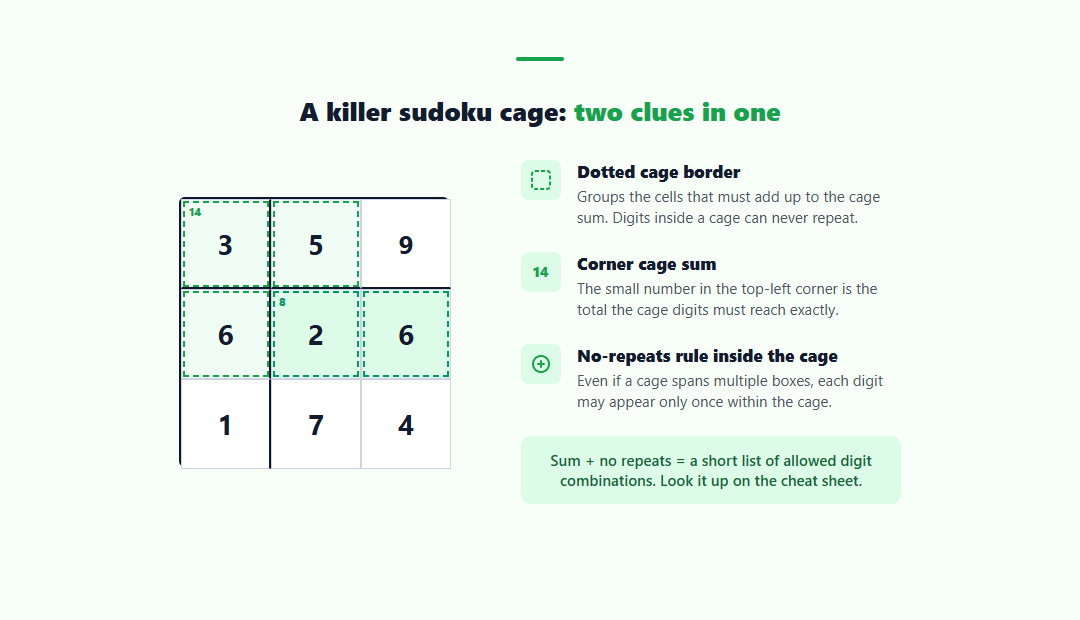
A cage is the dotted-outline group of cells in a killer sudoku, and the small number in its top-left corner is the cage sum — the total the digits inside must add up to. Unlike a normal sudoku box, the digits inside a cage can never repeat. So a cage is really two clues in one: a target total, and a no-repeats rule.
That is what makes the tables so powerful. For any cage, the size (how many cells) plus the sum (the corner number) narrows the contents down to a short list of possible digit combinations — sometimes to a single one. Here is how to read every table below:
- Count the cells in the cage and pick the matching table (2-cell, 3-cell or 4-cell).
- Find the row for the sum printed in the corner.
- Read across — those are the only digit combinations allowed in that cage. Every other digit can be crossed off straight away.
Each combination is written as a set like {1,4}, which means the digits 1 and 4 in either order. The cage tells you which digits; the rest of the sudoku tells you where each one goes.
Two-cell cage combinations
Two-cell cages are the friendliest clues on the board. The lowest possible sum is 3 ({1,2}) and the highest is 17 ({8,9}). Notice how the extremes have only one combination, while the middle sums (9, 10 and 11) each have four — the closer a sum sits to the edges, the fewer options you have, and the faster it solves.
| Cage sum | Possible combinations |
|---|---|
| 3 | {1,2} |
| 4 | {1,3} |
| 5 | {1,4}, {2,3} |
| 6 | {1,5}, {2,4} |
| 7 | {1,6}, {2,5}, {3,4} |
| 8 | {1,7}, {2,6}, {3,5} |
| 9 | {1,8}, {2,7}, {3,6}, {4,5} |
| 10 | {1,9}, {2,8}, {3,7}, {4,6} |
| 11 | {2,9}, {3,8}, {4,7}, {5,6} |
| 12 | {3,9}, {4,8}, {5,7} |
| 13 | {4,9}, {5,8}, {6,7} |
| 14 | {5,9}, {6,8} |
| 15 | {6,9}, {7,8} |
| 16 | {7,9} |
| 17 | {8,9} |
Three-cell cage combinations
Three-cell cages span sums from 6 ({1,2,3}) up to 24 ({7,8,9}). The middle sums (14, 15 and 16) each have eight combinations, so they tell you little on their own — but the low and high sums are gold. Any 3-cell cage of 6, 7, 23 or 24 has a single forced combination you can fill in straight away.
| Cage sum | Possible combinations |
|---|---|
| 6 | {1,2,3} |
| 7 | {1,2,4} |
| 8 | {1,2,5}, {1,3,4} |
| 9 | {1,2,6}, {1,3,5}, {2,3,4} |
| 10 | {1,2,7}, {1,3,6}, {1,4,5}, {2,3,5} |
| 11 | {1,2,8}, {1,3,7}, {1,4,6}, {2,3,6}, {2,4,5} |
| 12 | {1,2,9}, {1,3,8}, {1,4,7}, {1,5,6}, {2,3,7}, {2,4,6}, {3,4,5} |
| 13 | {1,3,9}, {1,4,8}, {1,5,7}, {2,3,8}, {2,4,7}, {2,5,6}, {3,4,6} |
| 14 | {1,4,9}, {1,5,8}, {1,6,7}, {2,3,9}, {2,4,8}, {2,5,7}, {3,4,7}, {3,5,6} |
| 15 | {1,5,9}, {1,6,8}, {2,4,9}, {2,5,8}, {2,6,7}, {3,4,8}, {3,5,7}, {4,5,6} |
| 16 | {1,6,9}, {1,7,8}, {2,5,9}, {2,6,8}, {3,4,9}, {3,5,8}, {3,6,7}, {4,5,7} |
| 17 | {1,7,9}, {2,6,9}, {2,7,8}, {3,5,9}, {3,6,8}, {4,5,8}, {4,6,7} |
| 18 | {1,8,9}, {2,7,9}, {3,6,9}, {3,7,8}, {4,5,9}, {4,6,8}, {5,6,7} |
| 19 | {2,8,9}, {3,7,9}, {4,6,9}, {4,7,8}, {5,6,8} |
| 20 | {3,8,9}, {4,7,9}, {5,6,9}, {5,7,8} |
| 21 | {4,8,9}, {5,7,9}, {6,7,8} |
| 22 | {5,8,9}, {6,7,9} |
| 23 | {6,8,9} |
| 24 | {7,8,9} |
Four-cell cage combinations
Four-cell cages run from 10 ({1,2,3,4}) up to 30 ({6,7,8,9}). The middle sums get busy — sum 20 has twelve combinations — so reach for the edges first. The real prizes are the forced cages: 10, 11, 29 and 30 each have exactly one combination.
| Cage sum | Possible combinations |
|---|---|
| 10 | {1,2,3,4} |
| 11 | {1,2,3,5} |
| 12 | {1,2,3,6}, {1,2,4,5} |
| 13 | {1,2,3,7}, {1,2,4,6}, {1,3,4,5} |
| 14 | {1,2,3,8}, {1,2,4,7}, {1,2,5,6}, {1,3,4,6}, {2,3,4,5} |
| 15 | {1,2,3,9}, {1,2,4,8}, {1,2,5,7}, {1,3,4,7}, {1,3,5,6}, {2,3,4,6} |
| 16 | {1,2,4,9}, {1,2,5,8}, {1,2,6,7}, {1,3,4,8}, {1,3,5,7}, {1,4,5,6}, {2,3,4,7}, {2,3,5,6} |
| 17 | {1,2,5,9}, {1,2,6,8}, {1,3,4,9}, {1,3,5,8}, {1,3,6,7}, {1,4,5,7}, {2,3,4,8}, {2,3,5,7}, {2,4,5,6} |
| 18 | {1,2,6,9}, {1,2,7,8}, {1,3,5,9}, {1,3,6,8}, {1,4,5,8}, {1,4,6,7}, {2,3,4,9}, {2,3,5,8}, {2,3,6,7}, {2,4,5,7}, {3,4,5,6} |
| 19 | {1,2,7,9}, {1,3,6,9}, {1,3,7,8}, {1,4,5,9}, {1,4,6,8}, {1,5,6,7}, {2,3,5,9}, {2,3,6,8}, {2,4,5,8}, {2,4,6,7}, {3,4,5,7} |
| 20 | {1,2,8,9}, {1,3,7,9}, {1,4,6,9}, {1,4,7,8}, {1,5,6,8}, {2,3,6,9}, {2,3,7,8}, {2,4,5,9}, {2,4,6,8}, {2,5,6,7}, {3,4,5,8}, {3,4,6,7} |
| 21 | {1,3,8,9}, {1,4,7,9}, {1,5,6,9}, {1,5,7,8}, {2,3,7,9}, {2,4,6,9}, {2,4,7,8}, {2,5,6,8}, {3,4,5,9}, {3,4,6,8}, {3,5,6,7} |
| 22 | {1,4,8,9}, {1,5,7,9}, {1,6,7,8}, {2,3,8,9}, {2,4,7,9}, {2,5,6,9}, {2,5,7,8}, {3,4,6,9}, {3,4,7,8}, {3,5,6,8}, {4,5,6,7} |
| 23 | {1,5,8,9}, {1,6,7,9}, {2,4,8,9}, {2,5,7,9}, {2,6,7,8}, {3,4,7,9}, {3,5,6,9}, {3,5,7,8}, {4,5,6,8} |
| 24 | {1,6,8,9}, {2,5,8,9}, {2,6,7,9}, {3,4,8,9}, {3,5,7,9}, {3,6,7,8}, {4,5,6,9}, {4,5,7,8} |
| 25 | {1,7,8,9}, {2,6,8,9}, {3,5,8,9}, {3,6,7,9}, {4,5,7,9}, {4,6,7,8} |
| 26 | {2,7,8,9}, {3,6,8,9}, {4,5,8,9}, {4,6,7,9}, {5,6,7,8} |
| 27 | {3,7,8,9}, {4,6,8,9}, {5,6,7,9} |
| 28 | {4,7,8,9}, {5,6,8,9} |
| 29 | {5,7,8,9} |
| 30 | {6,7,8,9} |
Five cells and larger? The same logic holds, but the lists get long and rarely worth memorising. The exception is the extremes again: a 5-cell cage of 15 can only be {1,2,3,4,5}, and a 5-cell cage of 35 can only be {5,6,7,8,9}. When a large cage is near its minimum or maximum, look it up the same way — count the cells, take the smallest (or largest) distinct digits, and check the total.
The “magic” unique sums to memorise
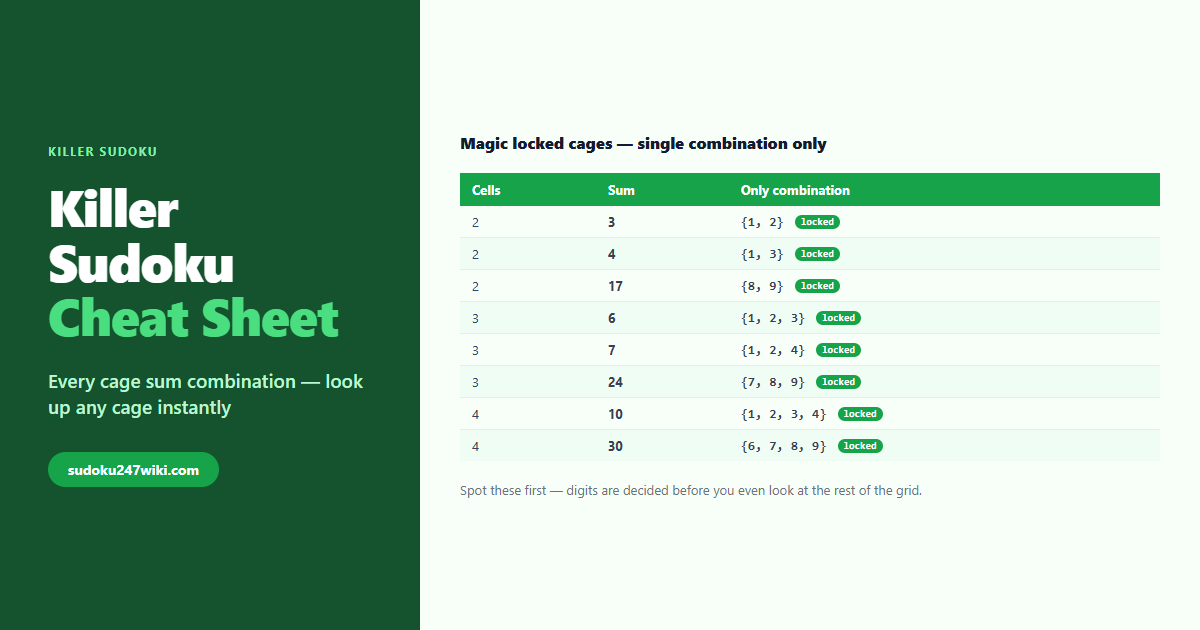
If you memorise only one thing from this cheat sheet, make it this list. These are the cages with a single possible combination — the moment you spot one, the digits are decided. You may not know the exact cell each digit lands in yet, but you have just removed every other candidate from those cells. These “locked” cages are where you start every killer puzzle.
| Cells | Sum | Only combination |
|---|---|---|
| 2 | 3 | {1,2} |
| 2 | 4 | {1,3} |
| 2 | 16 | {7,9} |
| 2 | 17 | {8,9} |
| 3 | 6 | {1,2,3} |
| 3 | 7 | {1,2,4} |
| 3 | 23 | {6,8,9} |
| 3 | 24 | {7,8,9} |
| 4 | 10 | {1,2,3,4} |
| 4 | 11 | {1,2,3,5} |
| 4 | 29 | {5,7,8,9} |
| 4 | 30 | {6,7,8,9} |
The pattern is easy to feel: every unique sum sits at the very bottom or very top of its range, where there is only one way to make the total without repeating a digit. Train your eye to scan for the smallest and largest cage numbers first — a corner clue of 3, 4, 16 or 17 in a 2-cell cage is an instant placement.
The 45 rule (cage sums in a region)
The combination tables tell you what fits inside a cage. The 45 rule tells you about everything around it. Because every row, column and 3×3 box of a sudoku contains the digits 1 through 9 exactly once, each of those regions always totals 1+2+3+4+5+6+7+8+9 = 45.
That fixed total is a second cheat sheet you never have to print. If the cages inside a row add up to 38, the leftover cell must be 45 − 38 = 7 — placed without ever looking at its own cage. The rule scales too: two stacked boxes total 90, three total 135. When you are stuck, find a row, column or box that is almost fully caged and add up the sums you know. The full method, with worked diagrams, lives in the killer sudoku rules, and you can read the short definitions in the sudoku glossary.
A worked cage example
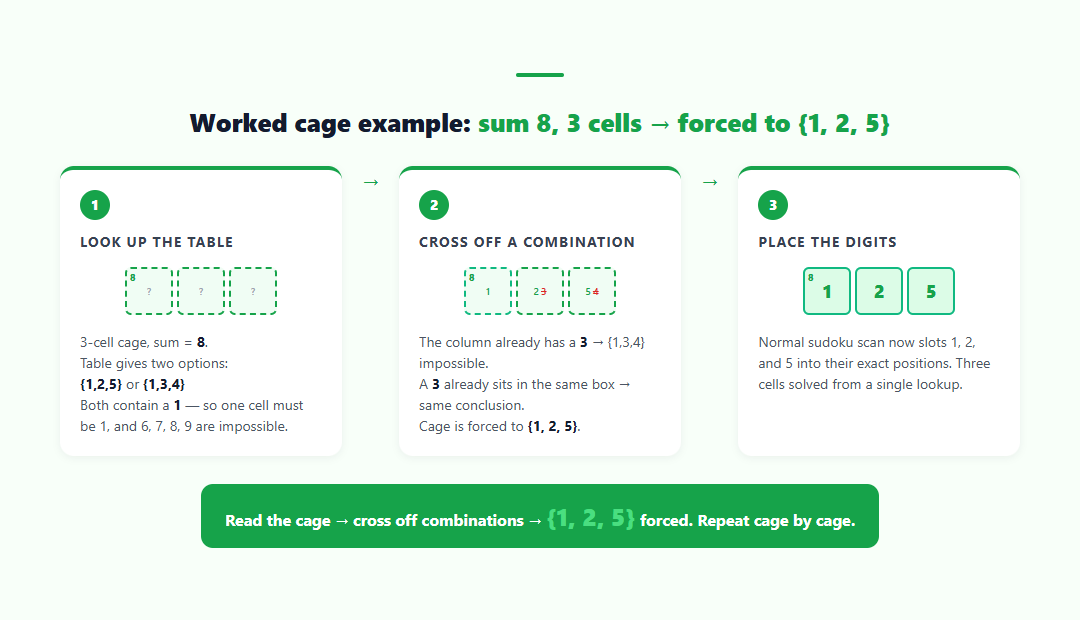
Here is the cheat sheet doing real work. Picture a 3-cell cage with the sum 8 in the corner. You count three cells, jump to the three-cell table, and find the row for 8:
Sum 8 (3 cells): {1,2,5} or {1,3,4}
Only two combinations — and look what they share. Both contain a 1. So whatever else happens, one of these three cells must be a 1, and none of them can be a 6, 7, 8 or 9. You have eliminated four candidates from three cells before placing anything.
Now bring in the surrounding grid. Suppose the column running through this cage already has a 1 placed elsewhere. A 1 cannot repeat in that column, so the cell of our cage that sits in that column cannot be the 1 — which means the 1 must go in one of the other two cells. And suppose a 3 already appears in the same box. Then {1,3,4} is impossible, because the cage could not hold its 3. The combination {1,3,4} is eliminated, and the cage is forced to be {1,2,5}.
From “three empty cells with a tiny 8 in the corner” you now know the exact three digits — 1, 2 and 5 — and a normal sudoku scan will slot each into place. That is the whole loop: read the cage from the table, then let the rest of the grid eliminate the leftover combinations. Repeat it cage by cage and the puzzle unravels.
Frequently asked questions
What is the lowest and highest possible cage sum?
The lowest sum depends on the cage size: a 2-cell cage bottoms out at 3 ({1,2}), a 3-cell cage at 6 ({1,2,3}), and a 4-cell cage at 10 ({1,2,3,4}). The highest are the mirror images — 17 for two cells ({8,9}), 24 for three ({7,8,9}) and 30 for four ({6,7,8,9}). These extremes always have just one combination, which is exactly why they are the first cages you solve.
How many combinations does a 3-cell cage of 15 have?
A 3-cell cage summing to 15 has eight possible combinations: {1,5,9}, {1,6,8}, {2,4,9}, {2,5,8}, {2,6,7}, {3,4,8}, {3,5,7} and {4,5,6}. That is the joint-most for any 3-cell cage (14 and 16 also have eight), so a 15-cage tells you little by itself — solve the locked cages around it first and let them whittle the options down.
What is the 45 rule in killer sudoku?
The 45 rule says that every row, every column and every 3×3 box totals 45, because each contains the digits 1 through 9 once (1+2+…+9 = 45). You use it by adding the cage sums inside a region: the difference between that total and 45 reveals the value of any leftover cell. It is the most powerful killer-specific technique — the full walkthrough is in the killer sudoku rules.
Do digits repeat inside a cage?
No. Digits can never repeat within a single cage, even when the cage spans more than one row, column or box. That no-repeats rule is what makes the combination tables work — every entry above is a set of distinct digits. You can read the precise definition of a cage and its sum in the sudoku glossary.
More from the blog
- What Does Sudoku Mean? Pronunciation, Origin & HistoryHow do you pronounce sudoku, and what does it mean? It’s “soo-DOH-koo” — Japanese for “single number.” Here’s the meaning, origin and short history.
- Stuck on a Sudoku? Here’s Exactly What to Try NextStuck on a sudoku with no obvious move? Work through this ordered checklist — re-scan, pencil marks, locked candidates, pairs — to break the deadlock.
- How to Solve Sudoku Faster: Smart Habits, Not RushingWant to solve sudoku faster? Learn the scanning discipline, notation and pattern-spotting habits that cut your time — without rushing into mistakes.
Practice online
Put it into practice on free puzzles with hints, notes and four difficulty levels.
Play Sudoku