Killer Sudoku Rules: 45-Rule, Cages & Strategy
Killer Sudoku rules explained: how cages and their printed sums work, the 45-rule that cracks any region, the cage-sum combinations, and a worked example.
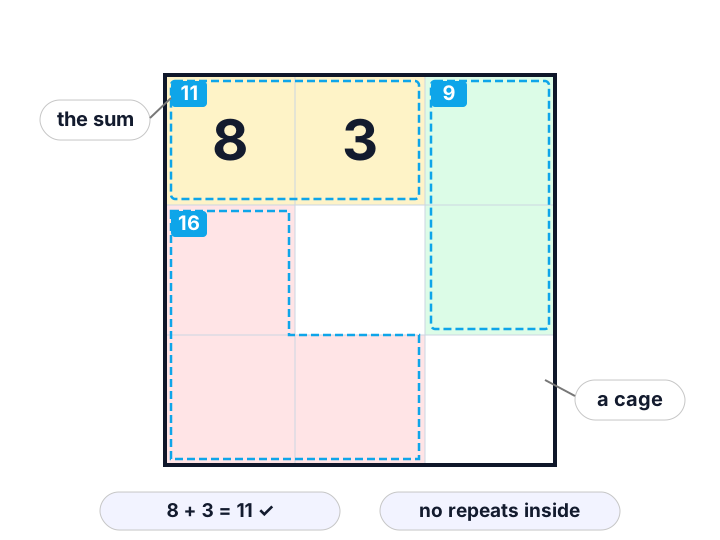
Killer Sudoku keeps every classic Sudoku rule and adds dotted "cages": small groups of cells each marked with a target sum in the top-left corner. The digits inside the cage must add up to that total, and — like a row, column or box — no digit may repeat inside a single cage. That last rule is the world standard; if you ever see a puzzle that allows repeats, the publisher will say so.
Most killer puzzles start with no given digits at all. The cage sums carry every piece of information. That is why killer feels intimidating at first — and why the techniques below pay off so quickly once you have them.
The rules
- All classic Sudoku rules apply: 1-9 once per row, once per column, once per 3×3 box.
- Each dotted cage shows a sum in its top-left corner. The digits inside the cage add to that sum.
- No digit repeats within a single cage (the world-standard convention).
- Cages can be any orthogonal shape and may span multiple boxes.
- Every row, column and box still sums to 45 — the foundation of the 45-rule technique.
The rules in plain English
A killer Sudoku is a 9×9 grid that obeys the three classic constraints: each row, each column and each 3×3 box contains the digits 1 to 9 exactly once. On top of that, the grid is fully tiled by cages — dotted shapes that group cells into a sum. Cages can be one cell, two cells, or any larger orthogonal shape that snakes across the grid; what they may not do is repeat a digit inside themselves. A two-cell cage marked "5" must be 1+4 or 2+3, not 2+3 in either order with the digits swapped freely — both digits still have to be different, and they still cannot break the row, column and box rules around them.
Single-cell cages are allowed. They are the easiest givens you will see: a "7" in a one-cell cage simply means that cell is a 7.
- Three classic rules: 1-9 once per row, once per column, once per 3×3 box.
- Cage rule: digits inside a dotted cage add to the printed sum.
- No-repeat rule: digits inside a cage are all different (the world-standard convention).
- Cages tile the whole grid — every cell belongs to exactly one cage.
How a killer puzzle starts
Open a killer puzzle and you will see a grid full of dotted shapes with small sums in their corners and almost no pre-filled digits. The puzzle is not asking you to add — it is asking you to use the sums to lock down which digits each cage can hold, then to combine those locked sets with the classic Sudoku constraints to place real digits.
The fastest opening move is to scan for "locked" cages: cages whose sum allows only one digit combination. A two-cell cage summing to 3 must be {1, 2}; a three-cell cage summing to 24 must be {7, 8, 9}. You do not yet know which cell in the cage gets which digit, but the candidate set has just collapsed from {1...9} to two or three digits per cell. That is enough to start cross-checking against the row, column and box those cells live in.
- No givens? That is normal — the sums are the puzzle.
- First scan: cages with a single legal digit combination ("locked sets").
- Then cross-reference each locked set against its row, column and box.
Two-cell sum combinations
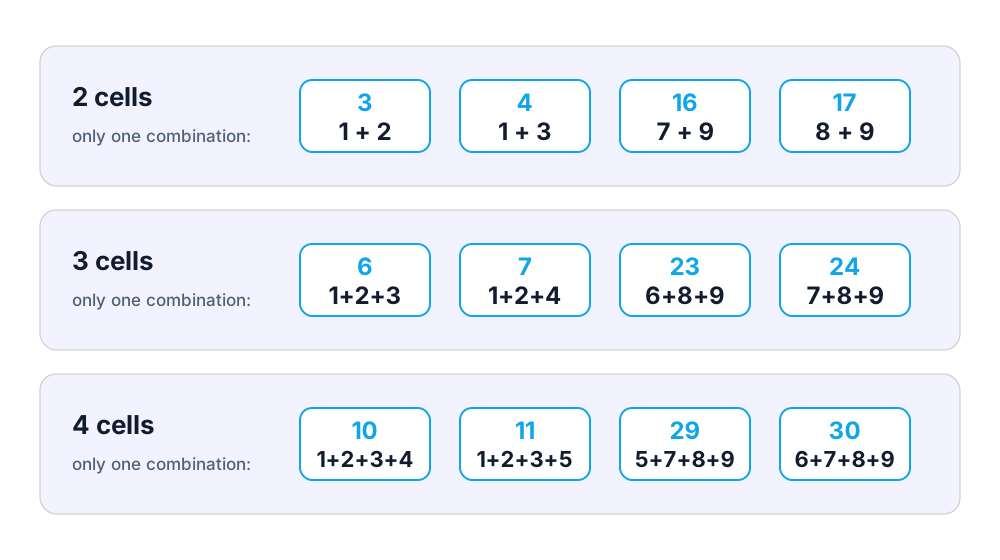
The single most useful reference in killer Sudoku is the table of digit combinations each sum allows. For two-cell cages the table is small enough to memorise, and the extremes do most of the heavy lifting: a sum of 3 or 4 has only one combination, and so does a sum of 16 or 17. Anywhere you spot one of those four sums, two specific digits are pinned to those two cells — you just need the rest of the grid to tell you the order.
The full two-cell table runs from 3 (smallest possible: 1+2) to 17 (largest: 8+9). Sums in the middle (9, 10, 11) admit four combinations each, so they tell you less on their own — but they still rule out, for example, the digit 5 from a cage summing to 17, which can be useful when 5 has nowhere else to go in the surrounding row.
- 2 cells, sum 3 → {1,2}; sum 4 → {1,3}.
- 2 cells, sum 16 → {7,9}; sum 17 → {8,9}.
- 3 cells, sum 6 → {1,2,3}; sum 7 → {1,2,4}; sum 23 → {6,8,9}; sum 24 → {7,8,9}.
- A unique-combination cage turns into a "locked set" the rest of the puzzle has to work around.
The 45-rule: every region totals 45
Because every row, column and 3×3 box contains the digits 1 through 9 once, every row, column and box sums to 1+2+3+4+5+6+7+8+9 = 45. This is the 45-rule. On its own it looks trivial; combined with cage sums it is the most powerful killer-specific technique there is.
To apply it, pick a region (a row, column or box) where most of the cages are fully contained inside it. Add the cage sums. If exactly one cell of the region sits outside those cages (the "innie"), that cell must equal 45 minus the total of the contained cages. If exactly one cell of a partially-contained cage sticks out of the region (the "outie"), that outside cell must equal the contained cage sums minus 45. Either way you have just placed — or tightly bounded — a digit without touching a single cell-by-cell candidate.
The trick scales. Two stacked boxes sum to 90, three to 135, and so on. Killer solvers routinely combine the 45-rule across two or three regions to crack puzzles that look impossible cell-by-cell.
- One region = 45. Two regions = 90. Three regions = 135.
- Innie: one uncovered cell inside the region = 45 − (contained cage sums).
- Outie: one cell of a cage poking out of the region = (cage sums) − 45.
- The 45-rule is the killer-specific equivalent of locked candidates in classic Sudoku.
A worked deduction
Here is the simplest killer move there is. Imagine the top row of the grid contains four cages fully inside it. Their sums are 12, 8, 14 and 6, totalling 40. The four cages cover eight of the nine cells in the row. The ninth cell — the innie — is part of a different cage that mostly lives in row 2.
By the 45-rule, those nine cells sum to 45. The eight covered cells sum to 40. So the innie cell must be 45 − 40 = 5. You have placed a digit without ever looking at the cage that contains it. That single deduction will cascade: a 5 in the row eliminates 5 from every other cell in row 1, narrows the cage in row 2 it belongs to, and often unblocks the next move.
Most "I am completely stuck" moments in killer puzzles dissolve under the 45-rule applied to a different region. When standard scanning stalls, look for any row, column or box that is "almost fully caged" and start adding.
- Pick a region almost fully covered by cages.
- Add the contained cage sums.
- Innie = 45 − the total. Place it. Re-scan.
After the start: standard techniques apply
Once cage logic has placed a handful of digits and tightened the candidate sets, killer Sudoku becomes a normal Sudoku again. Naked singles, hidden singles, naked pairs and pointing pairs all apply — only now they apply to cage-restricted candidate sets, so they fire more often than they would in a classic grid.
A reliable killer order of attack: locked cages first (unique-combination cages), then the 45-rule on tightly-caged regions, then naked and hidden singles on what the first two have left, then pairs and pointing pairs. Reach for fish, wings and chains only when none of those move the grid forward — and on most killer puzzles, you will never need them.
- Locked cages → 45-rule → singles → pairs → advanced techniques.
- Every classic deduction rule applies; the candidate sets are just tighter.
- Most killer puzzles finish on cage logic + singles + pairs alone.
Common mistakes to avoid
Two slip-ups account for almost every wrong move beginners make in killer. The first is forgetting that no digit may repeat inside a cage. A four-cell cage summing to 10 might look like it could be {1, 1, 4, 4} — but it cannot. The standard convention forbids the repeats. The legal combinations for a four-cell 10 are {1, 2, 3, 4} only. Always treat a cage as a small unit with its own no-repeat rule.
The second mistake is confusing the cage with the box. A cage is a sum group; a 3×3 box is one of the nine classic regions. They are different shapes and they have different rules. A cage spans whichever cells the puzzle designer drew it across — usually inside a single box, but often crossing two or three boxes. Cells in the same cage might be in different rows, columns and boxes, and that is fine.
- Cages forbid digit repeats — even though arithmetic alone would allow them.
- A cage is not a box: cages can cross boxes, and several cages live inside one box.
- Do not "add to solve". Killer is logic, not arithmetic — the sums are clues, not equations to solve directly.
Frequently asked questions
- Can a digit repeat inside a killer Sudoku cage?
- No — by the world-standard convention, no digit repeats within a cage. A four-cell cage summing to 10 cannot be {1, 1, 4, 4}; it must be {1, 2, 3, 4}. A digit still cannot repeat in a row, column or 3×3 box either, so the cage rule sits on top of the classic ones. A small number of older publishers allowed cage repeats; if a puzzle does, the rules text will say so explicitly.
- What is the 45-rule in killer Sudoku?
- Because every row, column and 3×3 box contains the digits 1 to 9 once, each of those nine-cell regions sums to 45. The 45-rule uses that fact: add the cages fully inside a region, and any uncaged cell ("innie") equals 45 minus the cage total, while any cage cell poking out ("outie") equals the cage sums minus 45. It is the fastest way to break a stuck killer puzzle and the technique most worth learning first.
- Where do I start a killer Sudoku puzzle?
- Start with cages whose sum has only one legal digit combination — two-cell sums of 3, 4, 16 or 17 are the classics, plus the three-cell extremes 6, 7, 23 and 24. Those cages become locked sets immediately. Then apply the 45-rule to any row, column or box that is almost fully covered by cages: an innie or outie there often places your first real digit.
- What are killer Sudoku cage combinations?
- Cage combinations are the sets of distinct digits that can add to a cage's printed sum given its size. A two-cell sum of 7 admits three combinations: {1, 6}, {2, 5} and {3, 4}. A three-cell sum of 24 admits only one: {7, 8, 9}. Memorising the small table for two and three-cell cages — especially the unique-combination sums at the extremes — is the single biggest speed boost in killer solving.
- Is killer Sudoku harder than classic Sudoku?
- Usually, yes — at least at first. Killer puzzles often start with no given digits, so you cannot scan for missing numbers the way you do in classic. But the cage sums carry a lot of information once you read them, and killer techniques (locked cages, the 45-rule) place digits very efficiently. After a few puzzles most solvers find an "easy" killer about as fast as a medium classic.
- Do I need to be good at maths to solve killer Sudoku?
- No. Killer uses arithmetic only at the level of adding small numbers — well within mental-arithmetic range. The puzzle is still pure logic: the sums are clues that narrow down which digits go where, not equations to solve. If you can add two single-digit numbers and remember a short combinations table, you have the maths covered.
- What is the difference between a cage and a 3×3 box?
- A 3×3 box is one of the nine fixed regions on every Sudoku grid — three cells tall, three wide, always at the same place. A cage is a sum group the killer designer drew on top of that. Cages can be any shape, span multiple boxes, and each box typically contains several cages. The rules apply separately: a digit must be unique inside its box and inside its cage.
Further reading
- Killer sudoku — Wikipedia
- The Killer Cage Convention — SudokuWiki.org
- Nikoli (publisher) — Wikipedia
Play Killer Sudoku online
Free Killer Sudoku puzzles in your browser — no download, no account needed.
Play Killer Sudoku