Sudoku Basics
Sudoku basics in plain English: the parts of the grid, what a candidate is, how pencil marks work, what difficulty levels actually mean, and where to start if you have never solved a puzzle.
Sudoku basics are the vocabulary every player uses before any solving technique makes sense. The grid has names for its pieces — cells, rows, columns, boxes — and the puzzle has names for the bits you work with — givens, candidates, pencil marks. Get the vocabulary down and the rest of the wiki reads like a friend talking, not a textbook.
This page is the on-ramp. If you have never solved a sudoku, start with the essay below — it explains what a candidate is, what each unit on the grid is called, how difficulty levels are graded, and which order to read the ten basics topics in. The card grid further down is those ten topics; come back to it as you go.
What "the basics" of sudoku really means
Before you can do a sudoku, you need names for the things you are reasoning about. The basics are not the rules — the rules fit in a sentence (each row, each column and each 3×3 box contains 1–9 once) and they belong on the how to play page. The basics are not the solving techniques either; the deduction rules that earn names like "naked single" and "X-Wing" live in the techniques cluster. The basics are everything in between: the words you need so the rules statement reads cleanly and the technique pages make sense.
In practice that means five small bodies of knowledge. First, the parts of the grid. Second, what givens and candidates are. Third, how pencil marks are written. Fourth, the shorthand people use to point at a specific cell. Fifth, what the difficulty label on a puzzle actually means. Each one is a few paragraphs of reading; together they are the smallest set you can have and still talk about sudoku properly.
- The parts of the grid — cell, row, column, box, unit, peer.
- Givens and candidates — the fixed clues, and the digits still legal in an empty cell.
- Pencil marks — how to record candidates without cluttering the grid.
- Notation — rNcN and the way rows, columns and boxes are numbered.
- Difficulty — what easy, medium, hard, expert, master and evil actually mean.
The parts of the grid you have to know
A classic sudoku is a 9×9 grid with 81 cells. The cells sit in nine rows numbered 1 to 9 from top to bottom, nine columns numbered 1 to 9 from left to right, and nine 3×3 boxes (sometimes called regions or blocks) marked by the heavier inside lines. Rows, columns and boxes are collectively called "units" — those are the groups the rule applies to, and they are the only groups the rule applies to.
Every cell belongs to exactly three units at once: one row, one column and one box. The cells that share a unit with a particular cell are its "peers" — there are 20 of them on a 9×9 grid (the other eight in your row, the other eight in your column, and the four extra cells in your box). When you place a digit, you immediately rule it out of all 20 peers. That overlap is the engine behind every deduction, which is why the next four basics pages keep returning to it.
Two wider groupings are useful too. Three boxes side by side make a "band"; three boxes top to bottom make a "stack". You will mostly see those words on technique pages — the names matter because some patterns (like the box/line reduction) live inside a single band or stack. For now, just know they exist. The grid anatomy page walks through all of this with a labelled diagram.
Givens, candidates and pencil marks — the bookkeeping
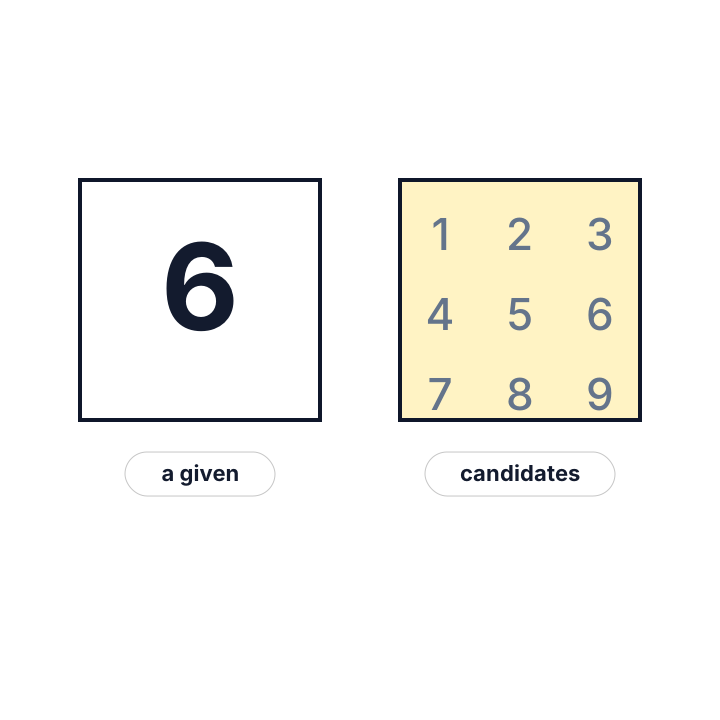
The digits printed at the start of a puzzle are the "givens" (some sites also call them clues). They are fixed, correct, and cannot be changed. A reputable puzzle ships with exactly enough of them to force a single solution, so if a solve ever seems to require changing a given, an earlier move of your own was wrong.
A "candidate" is a digit that could still legally go in an empty cell — one that does not already appear in that cell's row, column or box. Solving is the steady process of narrowing each cell's candidates down to one. On a fresh puzzle every empty cell has up to nine candidates; as you place digits, candidates fall away. When only one candidate is left in a cell, that cell is a "naked single" and the surviving digit is forced. The givens and candidates page is the full version of this.
Pencil marks are the small candidate digits you write into an empty cell to remember which numbers can still go there. The full pencil-mark method records every legal candidate in every cell — it fills the grid with tiny numbers, but it makes patterns visually obvious. Snyder notation, named after world champion Thomas Snyder, is sparser: you go box by box and digit by digit, and you only pencil a digit when it has exactly two possible cells in that box. Many fast solvers start every puzzle in Snyder notation and add full marks only if they get stuck. The pencil marks page compares both.
- A given is a digit printed at the start; it is fixed and correct.
- A candidate is a digit still legal in an empty cell.
- Full pencil marks record every candidate; Snyder notation records only digits with two candidate cells in a box.
Notation — how to name a cell out loud
To talk about a sudoku — in a guide, a forum, your own notes, or this wiki — you need a way to name a specific cell. The standard is rNcN notation: r for the row, c for the column, each followed by its number. The cell in the third row and fifth column is r3c5; the top-left cell is r1c1; the centre cell is r5c5; the bottom-right is r9c9. The wiki uses this shorthand throughout the technique pages, so it is worth learning before you read them.
The same convention numbers the units themselves. Rows are R1 through R9 from top to bottom; columns are C1 through C9 from left to right; boxes are 1 through 9 reading left to right then top to bottom (so box 1 is top-left, box 5 is the centre, box 9 is bottom-right). With this you can write a deduction unambiguously — for example, "5 is a hidden single in box 5 at r5c5." The notation page has the full convention with a labelled grid.
How difficulty levels actually work
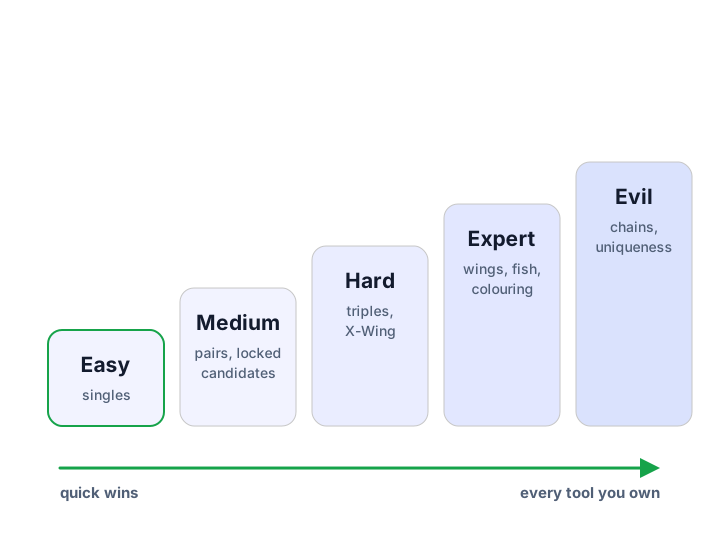
Sudoku difficulty is not about bigger numbers — every puzzle uses the same digits and the same rules. It comes from two things at once: how many givens the puzzle starts with, and which solving techniques it requires. Fewer givens is one signal (easy puzzles ship around 36–45 of them; expert grids can ship as few as 22–24). The harder signal is whether you can finish using only the simple deductions, or whether you have to reach for advanced patterns.
On the 9×9 board we offer six bands. Easy puzzles fall to direct scanning and have lots of givens. Medium puzzles need basic candidate tracking and hidden singles. Hard puzzles require naked or hidden pairs and locked candidates. Expert calls for fish like the X-Wing and wing patterns. Master grids need chains and colouring. Evil is the hardest band, with the fewest givens and the deepest logic. The 6×6 mini grid (2×3 boxes, digits 1–6) stops at hard — three levels total. The 4×4 kids grid (2×2 boxes, digits 1–4) ships a single easy level for first-time players. The difficulty levels page lists them all exactly.
One thing worth knowing early: clue placement matters as much as clue count. Two puzzles with the same number of givens can feel very different, because where the givens sit affects which deductions are available and in what order. That is also why a "proper" sudoku always has exactly one solution — see the unique solution page for why that guarantee is the whole point.
- 9×9 — six bands: easy, medium, hard, expert, master, evil.
- 6×6 mini — three bands: easy, medium, hard.
- 4×4 kids — one band: easy.
- Fewer givens and harder required deductions both push a puzzle up the ladder.
The reading order through the ten basics topics
The ten topics below are arranged in a deliberate reading order — orientation first, then rules, then anatomy, notation, grading, construction, and finally a guided first solve. If you are completely new, read them top to bottom. Each one is a short page (three to five minutes), so the whole set takes about forty minutes end to end. By the bottom of the list you will have solved an easy puzzle yourself.
If you already know how the grid works and want a specific gap filled, jump in. The sudoku rules page is the learner-friendly rules statement; the pencil marks page explains candidate mode and Snyder notation; the difficulty levels page explains what to expect at each level on each grid size. Anything that needs a name on this page is its own basics topic below — the essay positions them, the cards have the detail.
- 1. What Is Sudoku? — the puzzle in one minute.
- 2. The Rules of Sudoku — the rules statement in plain language.
- 3. Anatomy of a Sudoku Grid — cells, rows, columns, boxes, peers, bands, stacks.
- 4. Givens and Candidates — fixed clues vs digits still legal.
- 5. Pencil Marks, Candidate Mode and Snyder Notation — candidate mode, full marks vs the sparse Snyder style.
- 6. Sudoku Notation — rNcN cell coordinates and box numbering.
- 7. Sudoku Difficulty Levels — the bands per grid size.
- 8. Why a Sudoku Has One Solution — the uniqueness guarantee.
- 9. How Sudoku Puzzles Are Made — generation and clue removal.
- 10. Your First Sudoku: A Walkthrough — a real puzzle, step by step.
When you are done with the basics
You are done with the basics when you can name the parts of the grid, you understand what a candidate is, you know whether to write pencil marks in full or in Snyder style, and you have finished at least one easy puzzle in the first puzzle walkthrough. That is a low bar — and it is enough to start the next thing.
The next thing is the naked single. It is the simplest solving technique: a cell where only one candidate is still legal, so the surviving digit is forced. Pair it with the hidden single (a digit that has only one cell left in a unit) and you can finish almost every easy puzzle and most medium ones. After those, how to play covers the rules in their full pillar form and the solving order guide walks you through which technique to try in what order. The basics get you ready; the techniques get you solving harder grids.
Browse the basics topics
Ten short guides that take you from “what is Sudoku?” to solving your first puzzle.
- What Is Sudoku?Sudoku is a logic puzzle played on a 9×9 grid where every row, column and box must contain the digits 1–9 exactly once.
- The Rules of SudokuThe complete rules of classic Sudoku in plain language: fill the grid so each row, column and box holds the digits 1–9 once.
- Anatomy of a Sudoku GridThe parts of a Sudoku grid explained: cells, rows, columns, boxes, bands, stacks and the units that drive every deduction.
- Givens and CandidatesThe difference between givens (the fixed starting clues) and candidates (the digits still possible in an empty cell).
- Pencil Marks, Candidate Mode and Snyder NotationHow to record candidates with pencil marks and candidate mode, plus the disciplined Snyder method that keeps your grid uncluttered.
- Sudoku Notation (rNcN and Box Numbering)How to name a cell with rNcN coordinates and refer to rows, columns and boxes — the shared language for discussing puzzles.
- Sudoku Difficulty LevelsThe exact difficulty levels we offer for each grid size — six bands on 9×9, three on 6×6 mini, and one on the 4×4 kids grid.
- Why a Sudoku Has One SolutionA proper Sudoku has exactly one solution reachable by pure logic — the guarantee that makes guessing unnecessary.
- How Sudoku Puzzles Are MadeHow a Sudoku is generated: build a full solved grid, then remove clues while checking the solution stays unique.
- Your First Sudoku: A WalkthroughA beginner-friendly walkthrough of solving your first Sudoku, from scanning for easy placements to filling the grid.
Frequently asked questions
- What are the basics of sudoku?
- The basics are the vocabulary and bookkeeping every player uses before any technique makes sense — the parts of the grid (cells, rows, columns, 3×3 boxes, peers), what a given is (a fixed starting clue), what a candidate is (a digit still legal in an empty cell), how pencil marks work, the rNcN shorthand for naming a cell, and what each difficulty level actually requires. The rules of the game are separate (see how to play); the solving techniques are separate (see the techniques cluster). The basics are the bit in between.
- What is a candidate in sudoku?
- A candidate is a digit that could still legally go in a particular empty cell — one that does not already appear in that cell's row, column or 3×3 box. On a fresh puzzle every empty cell starts with up to nine candidates, and solving is the process of narrowing each cell's candidates down to one. When only one candidate is left, that cell is a "naked single" and the surviving digit is forced. Candidates are usually recorded as small pencil marks inside the cell.
- Do I have to write pencil marks to solve a sudoku?
- Not on easy puzzles. Easy grids fall to direct scanning — you can find hidden and naked singles without ever writing a candidate down. From medium upward, written pencil marks start to pay off, and on hard and expert puzzles they are essentially mandatory. Most players start with full pencil marks (every candidate in every empty cell) and graduate to Snyder notation (mark a digit only when it has exactly two candidate cells in a box) once the discipline becomes natural.
- What do easy, medium, hard and expert mean in sudoku?
- They describe the deductions a solve requires, not the digits used. On our 9×9 boards, easy is solved by direct scanning and ships about 36–45 givens; medium needs basic candidate tracking and hidden singles; hard requires naked or hidden pairs and locked candidates; expert calls for fish like the X-Wing and wing patterns; master needs chains and colouring; and evil — the hardest band — has the fewest givens and the deepest logic. The 6×6 mini grid stops at hard, and the 4×4 kids grid ships a single easy level.
- Can adults learn sudoku from scratch?
- Yes, and you do not need to be good at maths. Sudoku uses digits as labels, not quantities — there is no arithmetic. Everything is logical reasoning about where a symbol can or cannot go, and the same puzzle would play identically with nine letters or nine colours (Wordoku is the proof). A complete beginner can read the ten basics topics in about forty minutes and finish an easy puzzle the same afternoon. The harder bands take practice, not aptitude.
- How long does it take to learn the basics of sudoku?
- About forty minutes of reading plus one easy puzzle. The ten basics topics each take three to five minutes to read, and the last one is a guided walkthrough of a real puzzle. After that you can finish most easy puzzles on your own, although scanning speed grows over a couple of weeks of play. Learning the solving techniques — naked singles, hidden singles, then pairs and locked candidates — is a separate ladder that takes longer; the basics just get you to the bottom of it.
- What is the difference between the basics and the solving techniques?
- The basics are the vocabulary and bookkeeping you need before you can read a technique page — what a cell is, what a candidate is, how to write pencil marks, how to name a cell with rNcN. The solving techniques are the named deduction rules you apply during a solve — naked single, hidden single, naked pair, X-Wing and so on. You have to know the basics before the techniques make sense; you do not have to know every technique to enjoy sudoku. Most players solve happily with five or six techniques.
When you are done with the basics
The basics get you ready. The naked single and the hidden single get you solving.
Naked single
The simplest technique: a cell with only one legal digit left.
Hidden single
A digit with only one cell left in a row, column or box.
How to play sudoku
The three rules, the parts of the grid and how to find your first move.
Solving techniques
The full library of 25 deduction rules, ordered beginner to expert.
Further reading
- Sudoku — Wikipedia
- Glossary of Sudoku — Wikipedia
- Solving Techniques — overview — HoDoKu
Practice online
Put it into practice on free puzzles with hints, notes and four difficulty levels.
Play Sudoku