Wordoku Rules
Sudoku played with nine letters instead of digits — sometimes spelling a hidden word.
Wordoku (or Letter Sudoku) is classic Sudoku with nine distinct letters in place of the digits 1–9. The rules are unchanged; only the symbols differ. Many wordoku puzzles choose their nine letters so that a row, column or diagonal spells a word.
Because letters carry no numerical order, wordoku trains pure pattern logic.
The rules
- Fill every cell with one of the nine puzzle letters.
- Each row contains all nine letters once.
- Each column contains all nine letters once.
- Each 3×3 box contains all nine letters once.
Letters as symbols
Pick any deduction you would make with numbers and apply it to letters: each row, column and box must contain all nine letters exactly once. The hidden-word twist is a bonus, not a rule.
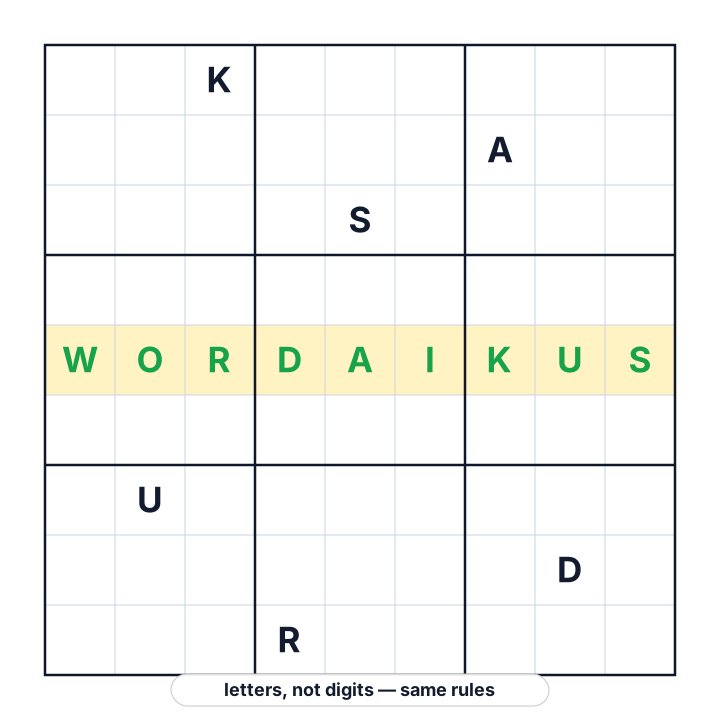
Solving with letters
The only real difference from number Sudoku is scanning speed: without a natural 1-2-3 order, your eye takes longer to notice a missing symbol. Two habits fix this. First, fix the alphabet order of the nine letters in your head and scan in that order every time. Second, lean on full pencil marks earlier than you would on a numeric grid, because naked and hidden singles are harder to spot by eye.
If the puzzle advertises a themed word, you can sometimes seed a whole line from it — but treat that as a head start, never as a substitute for the logic.
- Decide a fixed order for the nine letters and scan in it.
- Use pencil marks sooner — singles hide better among letters.
- A themed word can seed a line, but verify by logic.
A worked example
Let's place one letter the slow, deliberate way. Say the puzzle's nine letters are C, L, E, A, N, R, I, S, T — the word CLEANRIST is a jumble you'll never lean on, so first do the one thing that makes wordoku feel like numbers: fix a scanning order. Read them as C-L-E-A-N-R-I-S-T and use that order every single time, the way you'd reflexively run 1-2-3-4-5-6-7-8-9.
Now take the top-left box and hunt for the letter A. Scan that box in your fixed order until you reach A. Suppose A already appears in the box's top row and in its left column, thanks to letters placed elsewhere. That leaves just one empty cell in the box where A is still legal — every other empty cell shares a row or column with an existing A. That one cell is a hidden single: A must go there. The deduction is exactly the hidden single you'd make with the digit 4 in number Sudoku; only the symbol changed. The lesson is simple — the logic is identical, but without a built-in counting order your eye needs you to supply one, so scan letters in the same order, every box, every time.
- Lock the nine letters into one fixed order and always scan in it.
- To place a letter, eliminate the cells that share a row, column or box with an existing copy.
- One legal cell left for that letter is a hidden single — identical to numeric Sudoku, just with letters.
Frequently asked questions
- Is wordoku different to solve than number Sudoku?
- No — the logic is identical. Letters can feel harder only because they lack a natural order to scan by.
- Does the hidden word help solve it?
- Occasionally, if you spot the themed line early, but it is a flourish rather than a solving aid.
- Any tips for scanning letters quickly?
- Fix the nine letters in a set order in your mind and always scan in that order, and reach for full pencil marks a little sooner than you would on a numeric grid. Both compensate for the lack of a natural counting sequence.
Play Wordoku online
Free Wordoku puzzles in your browser — no download, no account needed.
Play Wordoku