How to Solve Sudoku Faster: Smart Habits, Not Rushing
Published Jun 24, 2026
You solve sudoku faster by changing your method, not your speed. The quickest solvers do not move their pen any faster than you do — they just waste fewer moves. They scan the grid in a smarter order, write fewer pencil marks, and recognise patterns the moment they appear. This guide walks you through those habits, one at a time, so you can shave minutes off your time without rushing into the mistakes that cost you even more.
Speed comes from method, not rushing
Here is the trap almost everyone falls into: you decide to go fast, so you start guessing. You pencil in a number that feels right, build on it, and ten minutes later you hit a contradiction. Now you have to unwind every move you made — and you are slower than if you had gone carefully from the start.
Real speed comes from never making that move in the first place. Every digit you place should be one you can prove. When each placement is certain, you never backtrack, and not backtracking is where the time actually disappears. So the goal is not to think faster. It is to think in the right order and skip the work that does not pay off.
For context: a comfortable recreational pace is roughly 5–15 minutes for an easy puzzle, 10–20 for a medium, and 20–45 for a hard one. If you are well inside those ranges and still accurate, you are already solving efficiently. The habits below are how you keep pushing the lower edge.
Scan by number, not by cell
This is the single highest-leverage habit, and it is the one most beginners get backwards. Do not stare at an empty cell asking “what could go here?” — that forces you to weigh nine possibilities at once. Instead, pick a digit and ask “where must this digit go?”
Take the digit 1. Run your eye across every row, column, and box that already contains a 1, and notice the cells those existing 1s rule out. Very often a single box is left with exactly one square where a 1 can legally sit. That is a forced placement, and you found it by looking at one number instead of one cell. Work through 1 to 9 this way and the easy placements fall out in a steady rhythm.
Scanning by cell makes you re-examine the whole grid for every blank. Scanning by number lets the digit you already know do the eliminating for you. It feels counterintuitive at first, then it becomes the fastest thing you do.
Use efficient notation (Snyder)
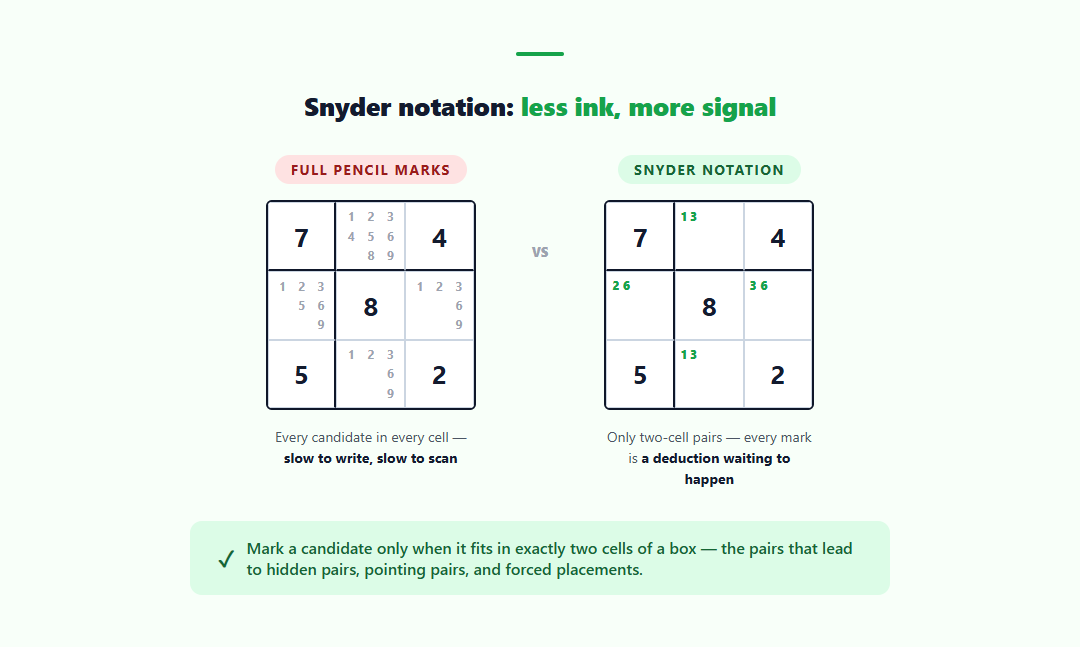
When scanning is no longer enough, you reach for pencil marks — and this is where most solvers slow themselves down. Writing every candidate into every cell fills the grid with clutter you then have to read and re-read. It is slow to write and slow to scan.
Snyder notation fixes that. Instead of marking everything, you mark a candidate only when it can go in just two cells within a box. Those two-spot pairs are exactly the marks that lead to deductions — hidden pairs, pointing pairs, and forced placements jump straight off the page. You write a fraction of the marks, and the ones you write are the ones that matter.
Less ink, more signal. That is the whole idea. Learn the discipline once and your mid-game gets noticeably tidier and quicker.
Recognise patterns on sight
Fast solvers do not re-derive the same logic every game. They have seen the common shapes so many times that they spot them instantly and act. Three are worth committing to memory first:
- Hidden single — a digit that can only go in one cell of a row, column, or box, even though that cell has other candidates too. The workhorse of fast solving.
- Naked pair — two cells in a unit that share the same two candidates. They lock those two digits between them, so you can erase both from every other cell in the unit.
- Pointing pair — when a candidate in a box is confined to one row or column, it eliminates that candidate further along the same line.
Once these are automatic, you stop “solving” them and start simply seeing them. The full library of named patterns lives in our techniques hub — work through them in order and each one becomes a reflex.
Work the most-constrained areas first
Not all parts of the grid are equally worth your attention. The boxes, rows, and columns that are already mostly filled have the fewest blanks and the most constraints — which means they are most likely to yield a forced placement right now. Start there.
Every digit you place tightens its neighbours, which often unlocks the next one nearby. Solving in dense clusters lets that chain reaction carry you, rather than hopping around the grid and reloading your focus each time. The same digit you have been scanning is also a good anchor: finish what it can give you across the whole grid before you switch to the next number. For the full sequencing strategy, see our guide to choosing a solving order.
Practise to build speed
Every habit above gets faster with reps, and there is no shortcut around that. The trick is to practise the right things. Solve at a difficulty where you almost never have to guess, so you are drilling clean technique rather than reinforcing bad ones. Once a level feels routine, step up.
Timing yourself helps — but treat the clock as feedback, not pressure. Watch where the seconds go. If you stall in the mid-game, your notation needs work. If you miss easy placements, your scanning order needs work. Fix the specific bottleneck and your time drops on its own.
Ready to put it all together? Our full guide to solving sudoku faster walks through scanning discipline, Snyder notation, pattern recognition, and a practice plan as one complete method — the deeper reference behind everything you just read.
Frequently asked questions
What’s a good sudoku time?
For everyday solvers, roughly 5–15 minutes on an easy puzzle, 10–20 on a medium, and 20–45 on a hard one are healthy benchmarks. These are practical ranges, not official standards — your pace depends on the puzzle’s clue count and the techniques it needs. Speed-solving champions finish easy grids in under a minute, but accuracy at a steady pace beats raw haste for almost everyone.
Does notation slow me down?
Marking everything slows you down — full pencil marks take ages to write and clutter the grid. Efficient notation does the opposite. Snyder notation, where you only mark a candidate when it fits in just two cells of a box, gives you far fewer marks while surfacing the exact pairs that lead to deductions. The right notation is a speed tool, not a tax.
How do experts solve so fast?
Experts almost never guess and almost never backtrack. They scan by number to find forced placements, use minimal notation, and recognise common patterns instantly instead of re-deriving them each time. The visible speed is just the absence of wasted moves — every digit they place is one they can prove, so the solution unfolds in one clean pass.
More from the blog
- What Does Sudoku Mean? Pronunciation, Origin & HistoryHow do you pronounce sudoku, and what does it mean? It’s “soo-DOH-koo” — Japanese for “single number.” Here’s the meaning, origin and short history.
- Stuck on a Sudoku? Here’s Exactly What to Try NextStuck on a sudoku with no obvious move? Work through this ordered checklist — re-scan, pencil marks, locked candidates, pairs — to break the deadlock.
- Killer Sudoku Cheat Sheet: Every Cage Sum CombinationThe complete killer sudoku cheat sheet: every 2-, 3- and 4-cell cage sum and its possible digit combinations, plus how to use the tables to solve faster.
Practice online
Put it into practice on free puzzles with hints, notes and four difficulty levels.
Play Sudoku