What Does Sudoku Mean? Pronunciation, Origin & History
Published Jul 15, 2026
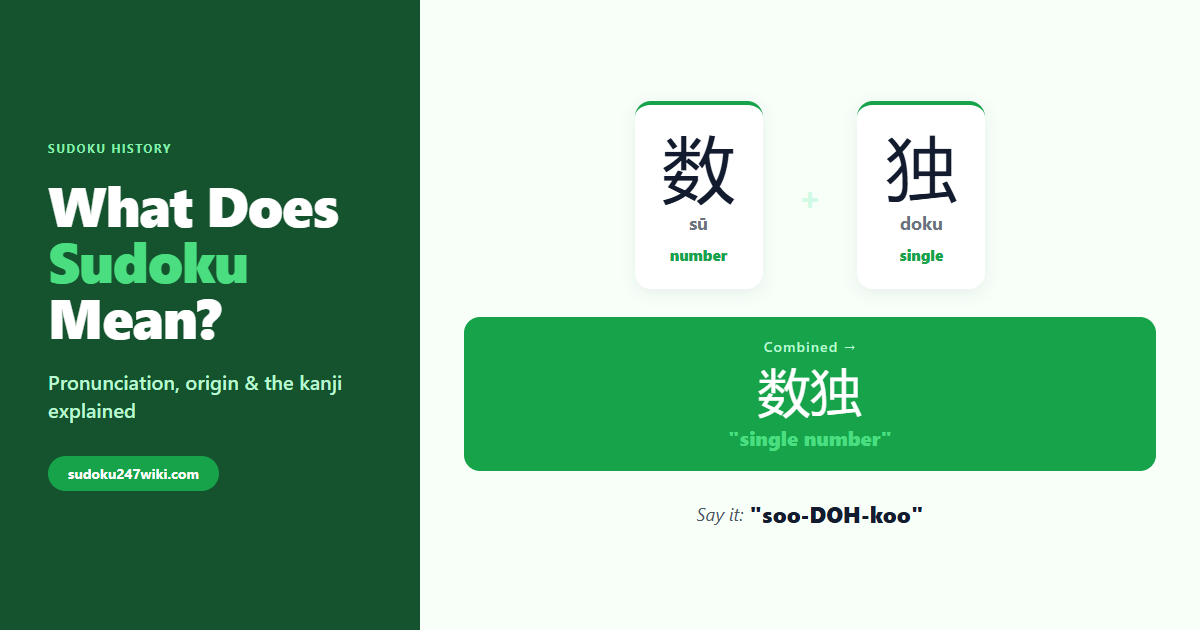
You say it “soo-DOH-koo” — three syllables, with the stress on the middle one. And it means, more or less, “single number.” The name is short for a Japanese phrase about digits that are allowed to appear only once. That’s the quick answer. The fuller story — where the word comes from, what the kanji actually mean, and why “sudoku” isn’t quite as Japanese as it sounds — is genuinely fun. Let’s dig in.
How do you pronounce sudoku?
Sudoku is pronounced “soo-DOH-koo” (in phonetic notation, /suːˈdoʊkuː/). Three syllables, with the emphasis on the second one — DOH. Think “Sue” + “dough” + “coo.”
- soo — like the name “Sue.”
- DOH — like “dough” (this is the stressed syllable).
- koo — like a dove’s “coo.”
You’ll sometimes hear “suh-DOH-koo” or “soo-DOH-koh” in casual speech, and nobody will blink. But the dictionary-standard form — the one both Merriam-Webster and the Oxford English Dictionary land on — is “soo-DOH-koo.”
What does sudoku mean?
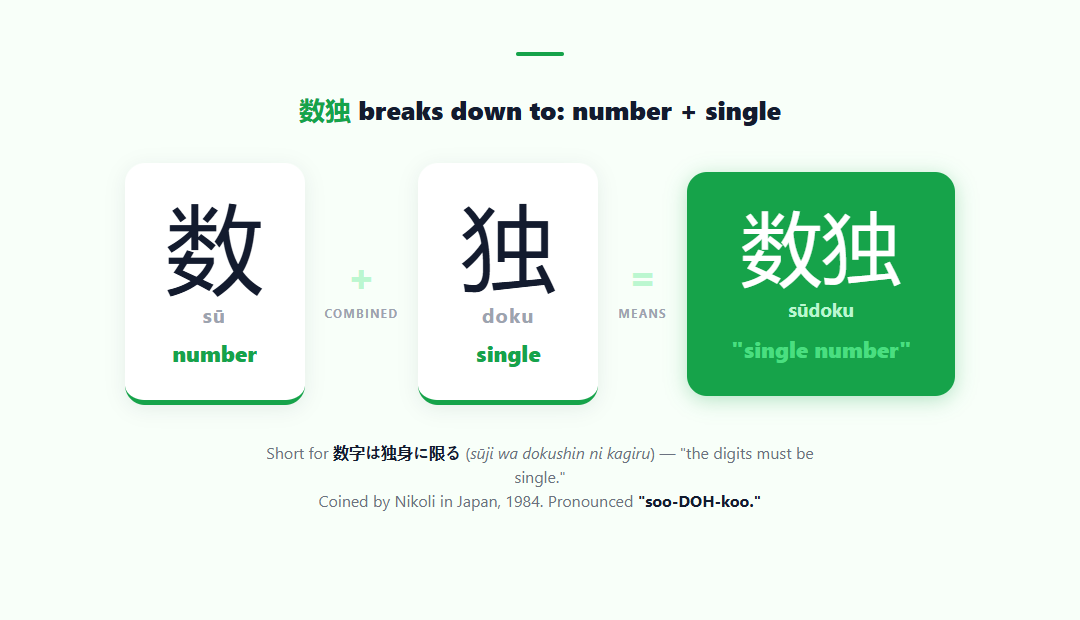
Sudoku means, in essence, “single number.” The word is Japanese — written 数独 (sūdoku) — and it’s a shortened form of the longer phrase sūji wa dokushin ni kagiru (数字は独身に限る), which translates roughly as “the digits must be single.”
That phrase is a neat description of the puzzle’s one rule: every number is limited to a single appearance in each row, each column, and each box. In Japanese, dokushin literally means “unmarried” or “single” — so the original phrase has a charming double meaning, as if each digit had to stay celibate, never repeating itself in the same line.
When the name was shortened to 数独, only the first kanji of two key words were kept: 数 from sūji (number) and 独 from dokushin (single). Put them together and you get “number-single” — or, as it’s usually glossed, “single number.”
The Japanese origin of the name
The name 数独 was coined in Japan by the puzzle publisher Nikoli. Nikoli introduced the puzzle to Japanese readers in April 1984 under the mouthful sūji wa dokushin ni kagiru, and the company’s president, Maki Kaji, later trimmed it down to the snappy “sudoku” we use today.
Two kanji do all the work:
- 数 (sū) — “number.”
- 独 (doku) — “single,” “alone,” or “independent.”
“Sudoku” is actually a registered trademark of Nikoli in Japan. That’s why, within Japan, many other publishers still call the same puzzle by its older name — Number Place (ナンバープレース). Which leads to a surprising twist.
Wait — sudoku isn’t actually Japanese?
The name is Japanese, but the puzzle almost certainly isn’t. The modern version is widely credited to Howard Garns, a 74-year-old retired architect from Indiana, who designed it for the American market. It first appeared in 1979, published by Dell Magazines under the plain English name “Number Place.”
So the timeline runs: an American invents the puzzle and calls it Number Place (1979), Nikoli picks it up in Japan and renames it sudoku (1984), and from there it goes global. The Japanese name is what stuck worldwide — which is why almost everyone assumes the puzzle was born in Japan. It wasn’t. Japan gave it its memorable name and made it a phenomenon, but the grid itself crossed the Pacific first.
A quick history
The short version: the puzzle’s deeper roots reach back to the Latin squares studied by the 18th-century mathematician Leonhard Euler, then surface as Number Place in 1979, get renamed sudoku by Nikoli in 1984, and explode into a worldwide craze in 2004–2005 after a New Zealander, Wayne Gould, got newspapers printing it daily.
That’s the whistle-stop tour. For the full journey — Euler, the newspaper boom, and how it became the puzzle in your morning paper — read the history of sudoku.
Try a puzzle
Now that you know what the word means, the best way to feel it is to fill a grid. New to it? Start with what sudoku is for the one-rule explainer, then head to the Sudoku247 Wiki to pick a puzzle and play. Each digit, single in its row, column, and box — exactly what the name promises.
Frequently asked questions
Is sudoku a Japanese word?
Yes — the word is Japanese, even though the puzzle isn’t. “Sudoku” (数独) was coined by the Japanese publisher Nikoli as a short form of sūji wa dokushin ni kagiru, “the digits must be single.” The puzzle itself was invented in the United States and first published in 1979 as “Number Place.”
How do you say sudoku in Japanese?
In Japanese it’s written 数独 and pronounced “soo-doh-koo,” much like the English version. It’s a contraction of 数字は独身に限る (sūji wa dokushin ni kagiru), combining 数 (number) and 独 (single) into “single number.”
What is the plural of sudoku?
In English, the usual plural is “sudokus” — for example, “she does two sudokus every morning.” You’ll also see “sudoku puzzles” used as the plural. Japanese nouns don’t change for number, so in the original language the word stays 数独 whether you mean one puzzle or many.
Who invented sudoku?
The modern puzzle is generally credited to Howard Garns, an American architect, who created it as “Number Place” for Dell Magazines in 1979. Nikoli of Japan renamed it sudoku in 1984, and Wayne Gould’s syndication helped trigger the global craze around 2004–2005.
More from the blog
- Stuck on a Sudoku? Here’s Exactly What to Try NextStuck on a sudoku with no obvious move? Work through this ordered checklist — re-scan, pencil marks, locked candidates, pairs — to break the deadlock.
- Killer Sudoku Cheat Sheet: Every Cage Sum CombinationThe complete killer sudoku cheat sheet: every 2-, 3- and 4-cell cage sum and its possible digit combinations, plus how to use the tables to solve faster.
- How to Solve Sudoku Faster: Smart Habits, Not RushingWant to solve sudoku faster? Learn the scanning discipline, notation and pattern-spotting habits that cut your time — without rushing into mistakes.
Practice online
Put it into practice on free puzzles with hints, notes and four difficulty levels.
Play Sudoku